


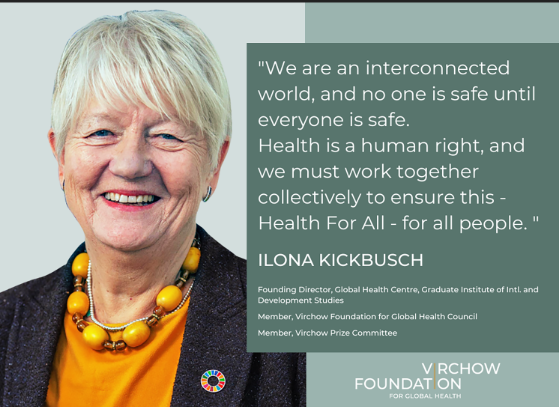
by Ilona Kickbusch, founder and chair of advisory board
Author affiliation: Geneva Graduate Institute, Graduate Institute of International and Development Studies, Geneva, Switzerland
BMJ 2026; 392 doi: https://doi.org/10.1136/bmj.s182 (Published 28 January 2026)
The US’s withdrawal from WHO makes Europe the system stabiliser in global health multilateralism, writes Ilona Kickbusch.
At the upcoming executive board meeting of the World Health Organization (WHO), European countries will need to position themselves in relation to the United States’ withdrawal from the agency.1 Although legal problems remain because the US has not paid its outstanding dues of $279m (£202m; €233m), member states need to face up to what this withdrawal means politically and institutionally. The US departure is a rupture in global health. One major consequence is that it fundamentally alters Europe’s strategic responsibility, leverage, and expectations about WHO governance and reform. This strategic thinking has not yet fully entered the global health debate. Instead, the focus has been on debating the intricacies of global health architecture rather than strategising geopolitically.
Without US funding in 2026/27, European countries would likely account for around 25% of WHO’s assessed contributions and about 40% of voluntary contributions, also including support from the EU and its institutions. This would make Europe the organisation’s dominant funding bloc, representing a systemic rebalancing of global health governance. Europe becomes the indispensable funder, not just “one of several large donors,” shifting how “Team Europe” works with WHO. The agreement between the EU and WHO, which is due for renewal in 2028, will also be influenced by this—maybe it needs to be revisited sooner to reflect the shift.
There is no way back to global health as we previously knew and shaped it. In this historic situation, Europe faces a strategic choice that requires a determined shared position: it can exercise leadership (normative, strategic, governance oriented) or remain cautious and risk a mismatch between its financial weight and a weak political voice. As a regional integration organisation, the EU has no voting rights in the WHO—coordinated EU statements are given through the country that holds the EU presidency. Yet this development means that Europe’s existing responsibility increases. Without any formal governance change, Europe would shape programme priorities, be central to financial stability, and carry reputational responsibility for WHO performance. The balance between influence and restraint is difficult to navigate, particularly given other geopolitical challenges and divides that have emerged in negotiations on the pandemic agreement and now on a Pathogen Access and Benefit Sharing system (PABS).
All experience in present geopolitics would warn against the cautious second option. Europe must become a proactive system stabiliser as the principal guarantor of WHO’s operational continuity, especially in relation to emergency preparedness and response, norm setting and guidance, and country support in fragile and conflict affected settings. Hopefully we will be surprised and soon hear a speech like the one Canadian President Mark Carney gave at the World Economic Forum at a WHO governance forum—clearly positioning Europe, its support of the WHO, and its expectations of reform, and reaching out to others to join it in this venture.
The key issues running through the executive board meeting agenda are clear. Assessed financial contributions from all member states need to increase. WHO needs to reevaluate priorities related to its constitutional functions in norms and standard setting, its role in upholding the integrity of science, and governance reforms to improve its functioning. The meeting is an opportunity to discuss the role of unearmarked and flexible voluntary funding with greater budgetary transparency and accountability of global health organisations and how they can work together effectively. WHO will remain structurally dependent on voluntary contributions, so it will be critical for European countries to support governance accountability between the WHO secretariat and major funders.
It will be straightforward to align this agenda with the core pillars of the EU Global Health Strategy. The strategy focuses on strengthening multilateralism, global health security, equity and universal health coverage, and normative leadership. The EU has already long advocated for reforms in three core areas: financing, governance, and accountability. The strategy (adopted in November 2022) proposes that WHO should focus its efforts on its core advantages: norm setting, emergency coordination, and global public goods for health. Therefore, an approach that highlights greater accountability aligns with the EU’s ambition to be a reliable multilateral actor.
A WHO without the US makes Europe the pivotal force in global health multilateralism—not China. If the member states of WHO work together, they can prevent a new great power rivalry in global health. Political leaders from Europe should speak out and confirm their commitment and alignment accordingly. Europe’s role will be to protect WHO’s multilateral character without replacing US dominance with European dominance. There is no need for a new hegemon in a world of distributed power. The WHO requires better governance overall, not control by a few. Europe can either passively absorb responsibility—or actively shape a stronger, more accountable, and more sustainable WHO and build a new global health alliance of middle powers from around the world. The priority will now be to coordinate European voices to actively shape reform and coordinate with others. As Prime Minister Carney said: “we need to build what we claim to believe in.”
Footnote
In this article Europe is used as the shorthand for the mix of EU27, candidate countries and accession candidates, as well as UK, Norway, Iceland, Switzerland, and Monaco. It is not equivalent to the 53 member states of the European Region of the WHO.