


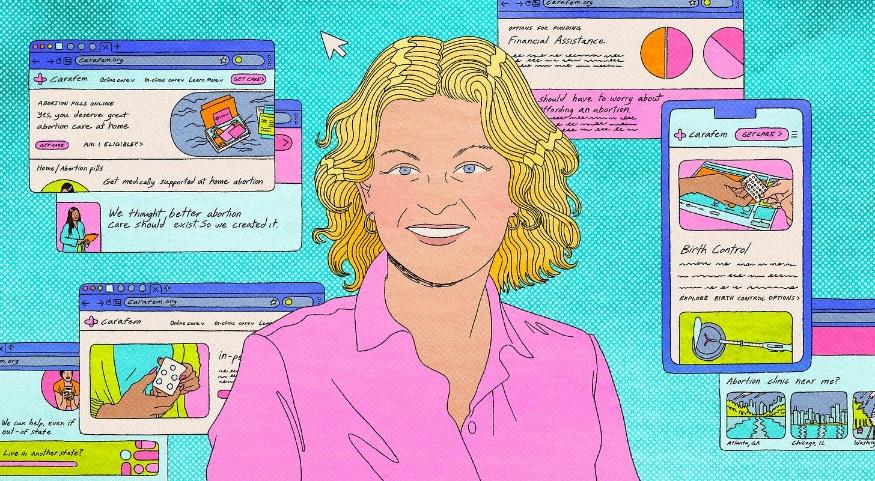
Today, telemedicine abortion accounts for nearly 30% of all abortions in the U.S. and nearly all abortions in states with severe restrictions. This certainly marks a shift for Melissa Grant, who’s been providing reproductive health care for 35 years. At the same time, Grant tells Abortion, Every Day the change isn’t necessarily as overwhelming as you might think: “You can trust patients to know what care they need and how they need it,” she said.
“Patients adapt faster than healthcare systems, and patients actually are more ready for better ways of doing things that fit their needs than oftentimes we are accommodating them with.”
Grant founded Carafem, an independent abortion provider, in 2013. Today, they provide both in-person and telehealth services in 21 states and the District of Columbia—at a time when both telemedicine abortion and independent providers are increasingly under attack.
As Abortion Every Day (AED) reported in December, 23 independent clinics shuttered in 2025 alone. Since the end of Roe in 2022, about 100 brick-and-mortar independent clinics have closed their doors. As this naturally creates greater need for telemedicine abortion services, the attacks on this option—a sham FDA ‘study,’ Louisiana’s lawsuit to end telemedicine, endless attacks in state legislatures, and even attempts to extradite abortion providers for mailing pills—are sharply on the rise.
Providing care under these constantly changing circumstances requires providers like Grant to be not just versatile and adaptable, she tells us, but also to trust that no matter what, her patients know their needs best.
Grant talked to AED about 35 years of getting it done, the international solidarity and exchange among providers, her patients’ stories, and the beauty of touching grass.
AED: What does an ordinary day—if such a thing exists in this line of work—entail for you?
MG: I’m currently the chief operations officer for Carafem, alongside our CEO who supervises care across about 100 countries. Wearing the CEO hat means I do a lot of different things, and that hat changes regularly. Overall, I help make sure that we’re living by the values of Carafem, that we’re making sure that patient care stays the north star, that we balance a budget. That really means making care that fits a patient’s life and bending to provide what they want more so than having patients fit into what we think their lives should be.
AED: How did you get involved in reproductive health care? What has this work looked like through the changing politics over the years?
MG: I’ve been in reproductive health care for over 35 years. As I was coming up in my life, with parents who were both advanced practice nurses and a stepfather who’s an OB/GYN, I was always immersed in this world, and I understood that abortion was common and normal. That was a part of my life since I was very young, it was just a fact.
When I was graduating from college, I was working at a university hospital system in an OB/GYN department, not really intending for that to be my career. But I loved working with the patients in that setting. When a Planned Parenthood opened in my community, I thought, well, that would be an interesting way to express my views and to help more people. And so I started working for them and have continued to do so in various states across the country, a little bit globally, and really never looked back. It’s been a really, really rewarding career and something that means a lot to me.
AED: What has your international work looked like?
MG: Across the U.S., I’d been training providers around providing mifepristone and misoprostol. I had been working with various clinics back when mifepristone was first approved, and we were an early medication abortion provider in the clinic I worked with. We were part of the research trials, and what that did is allow me to speak from real-world experience about what mifepristone was, how it worked, what patients found positive about it, what they liked about it, how is it different from providing procedural abortion, how can we best take this new treatment and make it work for a large number of people. I’m not sure how many different clinics I trained across the U.S. over a period of about five years.
And through that experience, I did my first international training with what’s now called MSI Reproductive Choices in London. I met so many providers through that traveling experience.
When we co-founded Carafem in 2013, we were looking for ways to hopefully simplify and demedicalize, to some extent, abortion care provision. Through my global work across so many different countries, we saw some of the very basics of health care remain the same, no matter who you’re serving, and it’s that people need care that fits with their own lifestyle, with their own understanding of their needs. That you can trust patients to know what they need and how they need it.
AED: What are some of the biggest challenges you face as an independent provider, even where you’re providing care in blue states?
MG: Where we’re providing care in blue and red states, it’s a good mix of both. In the most difficult of states, unfortunately, we had to relinquish the opportunity to provide care. So we had a clinic in Tennessee, and that one closed. We provided virtual care in Iowa, and that one had to close. We’ve had to learn a lot about working within various environments.
I think independent providers are innovators, and in that way, we’re able to move and change oftentimes more quickly than other providers. I think when innovation is personal, this helps to provide better service overall. Some of the challenges of working as an independent abortion provider are that our names aren’t as well known. Ultimately, organizations like Planned Parenthood, who have nationwide brand recognition, are easy to find. There are many, many really good independent providers who just don’t stand out as much across the U.S.
We’re always trying to work to make sure that we provide a really good patient experience, so that word of mouth and referrals, both from other patients, friends of patients, organizations that we partner with across the country, can draw more attention to our services. But it is harder not to have the name recognition.
AED: We’re in a moment of heightened attacks on telemedicine abortion. What’s changed and stayed the same in providing medication abortion through the years? What are some misconceptions?
MG:What I found is that honestly, patients adapt faster than healthcare systems, and patients actually are more ready for better ways of doing things that fit their needs than oftentimes we are accommodating them with. So, across the country, there have been more and more of us looking at different modalities to treat patients. It’s interesting that telemedicine options really came up due to the pressure of the (Covid) pandemic [in 2020] and the inability of people to travel. We know the majority of patients that seek abortion care already have children, so it was really interesting to see. How do you get health care to a person that has traditionally always only been provided in person? The ability to use the abortion pill, to think creatively about how to meet a patient, the flexibility, likely wouldn’t have occurred without the pandemic.
But I think the main, main lesson is in operationalizing this service for providers: we had to figure out how to do this in a way that was convenient, that was simple, that made sense. And patients quickly let us know what they wanted.
AED: Through these attacks on telemedicine abortion and the uncertainty, there must be confusion and anxiety among patients. What has it been like to meet them where they are and address their concerns?
MG: It’s really about providing simple, demedicalized information in a way that’s easily understandable; that’s the biggest challenge. What we have to do is to try to have healthcare that adapts to people, and not the other way around. People don’t separate abortion from the rest of their life. People are parents and students and professionals and caregivers, and they’re busy and they’re trying to figure things out. We just have to continue to find ways to make it make sense, to make it simple, to make it not just accessible but understandable.
AED: Tell us about who your patients are and what they’re often navigating.
MG: The circumstances of the patients that we serve are as broad as people are, and anyone can find themselves in a circumstance where they’re pregnant and need care. There are many commonalities. The biggest ones are simply that they have busy lives. There’s stigma around abortion, which makes it more difficult sometimes to ask questions. Sometimes anger—they don’t want to necessarily be in this place in the first place. Facing unintended pregnancy can sometimes feel like their power has been taken away from them.
With people living in rural communities that have to travel long distance, with people who do shift work, with people who are taking care of families, finding time that they can align their own schedule and needs—with women, we know they oftentimes put their own needs last on their calendar after their families. Telehealth allows someone to seek care 24/7, 365 days. We’re always here.
It’s also important to remember that telehealth isn’t for everybody. We need to allow patients to decide what fits best with their lifestyle. We owe them the opportunity in this country to provide in-person care as an option too. It’s just gotten a lot harder now that several states have restricted that option.
Trusting patients almost always works. They will tell you what they need if you give them the room to ask for it. The idea that convenience isn’t a luxury. Some of the biggest barriers aren’t always just the laws. It’s cost, it’s travel, it’s time off, it’s childcare, it’s privacy, it’s accuracy. All these things remain even when abortion is legal.
AED: How are you, personally, staying afloat through doing this work?
MG: One of the keys for a lot of us in the community that provide this care is that we live in a political zone for a good share of our time. A lot of people around the country, when they think of abortion, think of politics first. Hearing people passionately talk about limiting options is exhausting. So when I’m off work, I try to shut out the news cycle as much as I possibly can.
I think at a certain point it becomes destructive. So I try to walk away from it and spend time in nature whenever I can. A little sun on my face, get out among trees, animals, people that I care about and who love me. Those are the things that really matter, and they help regenerate my spirit. I think it’s important for all of us to do and to give each other the opportunity to care for ourselves.
SOURCE: Abortion, Every Day, by Kylie Cheung. At: https://jessica.substack.com/p/the-independent-telehealth-provider. 18 July 2026.