


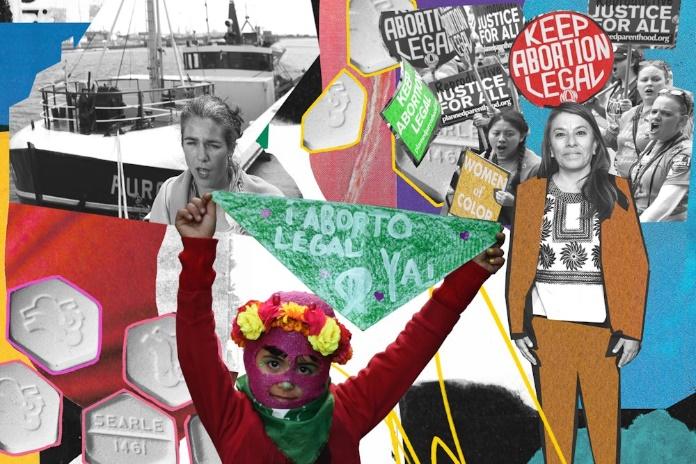
Illustration by Aaron Marin
Journalist Rebecca Grant shifts the abortion conversation away from laws and morals to focus on access: getting people the care they seek.
On a rainy evening in June 2001, abortion pirates sailed into Dublin harbor. Their converted fishing trawler had a portable clinic bolted to the deck, and the cargo included 20 doses of medication abortion (mifepristone and misoprostol), thousands of condoms, 120 IUDs, and 250 morning-after pills. The ship’s nearly all-female crew included a nurse and a gynecologist and was led by Rebecca Gomperts, a freckled and dark-haired Dutch doctor in her mid-thirties. The boat made its way up the River Liffey and docked close to a waiting crowd of activists and journalists.
The ship was Gomperts’s brainchild. At the time, the World Health Organization estimated that 78,000 women died each year from unsafe abortions, many of them in countries where abortion was criminalized or inaccessible. Using maritime law, which holds that a ship in international waters is governed by the laws of its home port, Gomperts thought she could sail a vessel from her home in the Netherlands, where abortion was legal, and provide abortion care offshore from countries where it wasn’t. It was a provocative and daring thing to do—“abortion pirates” was what conservative opponents called them—but Gomperts, who had served as a doctor on a Greenpeace ship in the late 1990s, knew the publicity power of direct-action campaigns and believed it was well worth creating a stir over 78,000 women’s lives.
In Ireland, a last-minute bureaucratic hold prevented the ship from handing out pills, but the crew began to take calls from women needing abortions and directed them to clinics in England or the Netherlands. They invited the public on board and cheerily handed out contraceptives, condoms, and information on safe, self-managed medication abortion. Gomperts’s organization, Women on Waves, has since sailed an abortion ship to Poland, Portugal, Spain, Morocco, Guatemala, and Mexico, and traveled to Venezuela, Ecuador, Tanzania, Chile, and Pakistan, where they worked with local activists to launch safe abortion hotlines or conduct trainings on self-managed abortion. Women on Waves has also sent drones carrying abortion pills into Poland and Northern Ireland, and robots carrying abortion pills, controlled from Amsterdam, into Northern Ireland and Mexico. On their website, you can see pictures of bewildered police officers trying to figure out how to arrest a robot.
Though the hotlines were long-term projects, the drones and robots in particular weren’t set up as sustainable models for abortion access. Instead, they were stunts intended to send a message: Access to abortion can’t be stopped, and women could—and would—self-manage their abortions safely, law be damned. As Gomperts put it, the project was this: “How could we create a space where the only permission a woman needed was her own?”
If Women on Waves was about making headlines, they were only the most visible part of a transnational and multigenerational movement, sensitively documented in Rebecca Grant’s new book, Access: Inside the Abortion Underground and the Sixty-Year Battle for Reproductive Freedom. Based on a decade of work as a reporter, Grant offers an immensely readable and deeply researched history, equal parts enraging and moving. Access interweaves profiles of activists around the world with deftly narrated context on science, politics, and history. We move from antebellum New York to 1960s Chicago, from Mexico in the 2000s to pharmacies in India, from the internet to an “undisclosed location in the American South” just before and after the Supreme Court drastically changed the legal landscape with its decision in Dobbs.

If Women on Waves was about making headlines, they were only the most visible part of a transnational and multigenerational movement, sensitively documented in Rebecca Grant’s new book, Access: Inside the Abortion Underground and the Sixty-Year Battle for Reproductive Freedom. Based on a decade of work as a reporter, Grant offers an immensely readable and deeply researched history, equal parts enraging and moving. Access interweaves profiles of activists around the world with deftly narrated context on science, politics, and history. We move from antebellum New York to 1960s Chicago, from Mexico in the 2000s to pharmacies in India, from the internet to an “undisclosed location in the American South” just before and after the Supreme Court drastically changed the legal landscape with its decision in Dobbs.
The conversation about abortion politics in the United States often focuses on laws—on winning rights and taking them away—and on morals. Grant, adamantly, focuses on access: getting people the reproductive care they seek. As the activists she profiles believe, and as her book illustrates, to focus on access is to wholly transform the conversation about what abortion is: a decision a woman makes, a procedure a woman has, something women will always seek regardless of laws. This is no small feat in a country where the anti-abortion right has successfully weaponized terms like life and heartbeat and baby and where mainstream abortion politics have been stuck in a defensive crouch of lobbying and debating “choice.” Reading Grant’s history raises the question: If Planned Parenthood had sent abortion boats down the Mississippi and into the Gulf of Mexico, working with local activists to build safe abortion hotlines in Texas, Florida, Louisiana, Alabama, would things look different today?
[This article is far too long to quote in full. It moves around the USA, taking in the range of efforts to maintain and increase access to safe abortion, in such a way that women only needed their own permission, and then travels down to Brazil, Mexico and Argentina in Latin America where the use of misoprostol for abortion on its own began and where law reform followed behind access and women’s helplines. Then it goes back to the US again, characterising each decade by the main events that took place.
When the Dobbs decision came down in 2022, invalidating Roe, one-third of reproductive-age women in the country lost legal access to abortion within two months, as red states enforced near-total bans. But the abortion pill had changed everything, and while activists looked to early heroines like the Janes, it was the work of groups like Las Libres that began to make the national news. Cruz told Grant she found her phone ringing nonstop after a major New York Times profile of Las Libres, as Americans called hoping to volunteer and offering to help ferry abortion medication from Mexico across the border.
“Alana,” an American expat living in Mexico, was friendly with Cruz, and asked if she might create a network of expat volunteers who could function as an American wing of Las Libres and handle all the new requests from the north. Cruz loved the idea, and Alana convened a “summit of the ‘old hippies,’” who sipped hibiscus tea while Alana told them she needed people to buy misoprostol in Mexico and smuggle it into Texas. One of the first to volunteer was Katie, a retiree in her sixties—and once Katie had success, it led to a trickle, and soon a stream, of older white women, nicknamed the “Juanas” after the Janes, carrying pills into the United States so that their granddaughters could enjoy bodily autonomy.
Grant’s book traces only a few of the many underground networks that likely exist—abortions actually increased nationwide in the year and half after Dobbs, with the flowering of telemedicine—and the book is itself an excellent guide to starting one of your own. As with the Janes, security protocol is paramount: Activists now use encrypted text messaging apps, no-log VPNs, encrypted email services like Proton Mail, and tracker-free browsers (helpfully listed, along with other abortion access resources, in an afterword to Access). These activists show in practice that to put women’s need for abortion at the center of the story is to see that abortion is about democracy, autonomy, and the ability to participate wholly in civic society. Unjust laws only change when people refuse to obey them, they argue, and it is to them that American women, now reduced to second-class citizenship after the loss of federal protections for abortion, are turning en masse. As such, Grant’s book should be required reading for every American.
In that Texas post office, Katie might have mailed the pills she carried to an activist in Louisiana, or New York, or Ohio, or Georgia, who would then carefully count the loose pills into proper dosages, package them, and ship them out to a list of addresses given to them by another member of the network. Packagers send along instructions, of course, but also sometimes handwritten notes or festive packaging; sometimes with earrings to disguise the pills’ jangling; sometimes with tea and ibuprofen—anything to help the person receiving them know that they are not alone.
SOURCE: New Republic, by Jessie Kindig, 4 August 2025.