


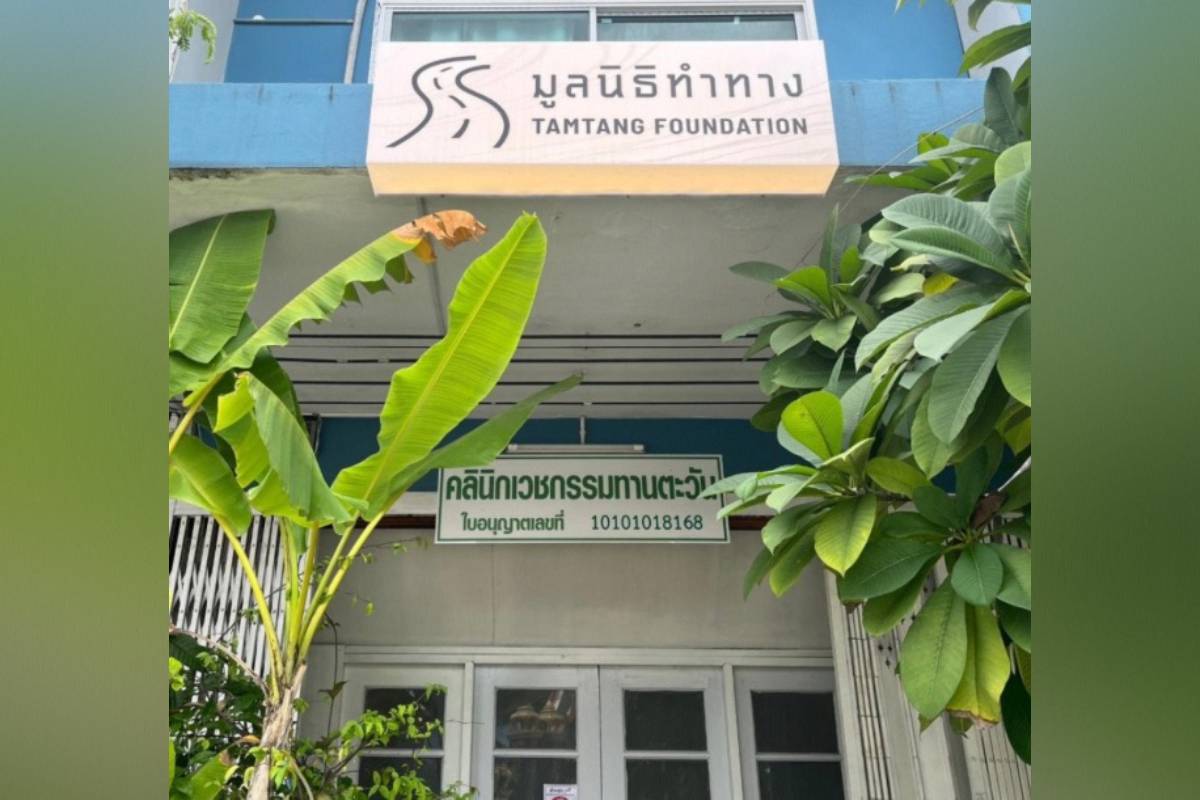
Tarntawan Clinic provides accessible abortion services centred on patient autonomy and psychosocial support. Warm and cosy — it is not only an abortion clinic, but a haven for women and LGBTIs to reclaim power over their bodies.
A sign of a beaming sunflower (tarntawan in Thai) juts out from a white and blue home office. Located on the ground floor, Tarntawan Clinic is offering a lifeline to abortion seekers who enjoy limited access to legal services. It provides medical abortion for those who are up to 12 weeks pregnant through telemedicine. Clients consult with staff online and receive abortion pills by post. On-site visits are allowed by appointment for privacy reasons. It is run by a team of doctors and counsellors.
Thailand’s policy to address its plunging birth rate focuses on ensuring pregnancies are safe and voluntary, yet it often conflicts with the practical realities of accessing legal abortion. While the government aims to reverse a 75-year low in fertility, health providers frequently impose non-legal hurdles that restrict reproductive autonomy.
Thailand is currently pushing to arrest a collapsing birth rate by focusing on safe and voluntary pregnancies. However, abortion remains largely inaccessible despite being legalized in 2021 for pregnancies up to 12 weeks. Advocacy groups like the Tamtang Foundation note that healthcare providers often demand unnecessary criteria, such as parental or partner consent, which are not required by law. These hurdles, combined with the high cost of private services and the covert nature of public facilities, create a significant gap between legal rights and actual service availability.
“Abortion should be seen as natural because women have long practised it, for example, by using herbs. Our service is offered in a friendly setting,” said Chonthita Kraisrikul, project manager for Tamtang Foundation, during the official launch on March 7. “We abide by the law that requires doctors to prescribe pills, but we don’t pry into private lives or have any formal dress code.”
Tamtang campaigns for access to safe and legal abortion in Thailand, mainly through consultations and coordination. It has developed this sandbox to narrow the gap between law and reality. Opened in August last year, the clinic has already served around 1,400 pregnant women, including Thais and foreigners.
Improving access to safe abortion
Abortion had been illegal in Thailand since 1957 until an amendment in early 2021. Criteria for legal abortion include threat to a mother’s life, foetal defect, and sexual assault. It allows termination for women who are up to 12 weeks pregnant, and women who are 12-20 weeks pregnant after medical consultation. Women over 15 can seek abortion without parental consent.
However, services remain largely inaccessible. According to last year’s data by Tamtang, there are around 150 abortion service providers out of 1,400 healthcare facilities.
Chonthita said private healthcare facilities disclose abortion availability, but charge higher prices (5,000-50,000 baht) for services according to the pregnancy stage. On the other hand, public healthcare facilities are more covert — they accept cases via coordination only, but charge affordable prices. She added that healthcare providers also have unnecessary criteria for legal abortion. Some require parental consent from abortion seekers, even though the age threshold is set at 15. Some require approval from male partners. Some request ultrasound scans (around 1,000 baht). Some reject repeat pregnancy cases unless they undergo sterilisation.
“All these hurdles are not stipulated by law. Our clinic has removed them,” she said.
Chonthita said the clinic plans to provide services free of charge. However, its request for subsidy is still on a waiting list. Currently, it charges around 1,500 baht for abortion seekers up to 10 weeks pregnant and 1,700 baht for those who are between 10 and 12 weeks. For those who have financial hardship, they are entitled to limited abortion funds or instalment payment.
Demedicalising abortion
Dr Chutinart Chinudomporn said despite legalisation, many doctors justify withholding services and referrals from abortion seekers on the grounds that it is taking away a life. Faced with resistance, especially from medical professionals, they are collaborating with the advocacy group to break the mould. “I was told that they are hesitant to have blood on their hands. It is difficult to change their worldview. Meanwhile, junior doctors are afraid to break ranks. We end up going our own way. I insist that abortion is a basic right. I want to return autonomy to abortion seekers,” she said.
Dr Chutinart said demedicalisation puts abortion seekers at the centre of decision-making, for example, through self-administering drugs at home, timing and sharing only needed information. Unlike cold, sterile facilities, the clinic is designed to create a friendly and safe atmosphere.
“When clients reach out to us, we simply verify who they are and if they make informed, autonomous decisions. By upholding their autonomy, we won’t inquire about reasons for abortion on the assumption that they already made deliberate choices. Instead, we provide a friendly sympathetic ear,” she said. After consultation, abortion pills are sent to abortion seekers by mail. Inside the package, there are drugs, manuals, handwritten greeting cards and cookies. “Psychosocial support for abortion seekers makes up most of our care. We never pry into their lives, but they feel comfortable to share stories with strangers,” she said.
And it comes down to economic reasons. Some financially struggle to afford kids. Others will lose jobs if they are pregnant. As clients are put at the centre, demedicalisation requires medical professionals to unlearn and relearn. It challenges the conventional belief that abortion must be performed by specialists (obstetricians and gynaecologists), when it can be provided by general practitioners. A friendly setting also necessitates her seeing patients as clients.
Dr Chutinart disputed that abortion availability leads to unprotected sex and unplanned pregnancy. At the heart of the issue, clients have limited access to barrier methods. For example, some disagree with making condoms available to students to avoid exposing them to sex too early. In fact, many students who seek help from us go to school the next day. It is a myth that having a solution leads to problems. If that is the case, then you should close drug rehabs,” she said. “Over 90% of our clients use protection, but they are not completely effective in preventing pregnancies.”
As Thailand has already become an aged society, Dr Chutinart said government policies to boost the population run counter to their campaign. “In fact, they are on the same spectrum. Some who have unwanted pregnancies may already have kids. Others who are not ready yet may be in a favourable position tomorrow. But the government wants the workforce now,” she said.
SOURCE: Bangkok Post https://www.bangkokpost.com/life/social-and-lifestyle/3217574/accessible-abortion-services?utm_source=taboola&utm_medium=deeperdive&utm_campaign=oc. View our policies at http://goo.gl/9HgTd and http://goo.gl/ou6Ip. © Bangkok Post PCL. All rights reserved.