


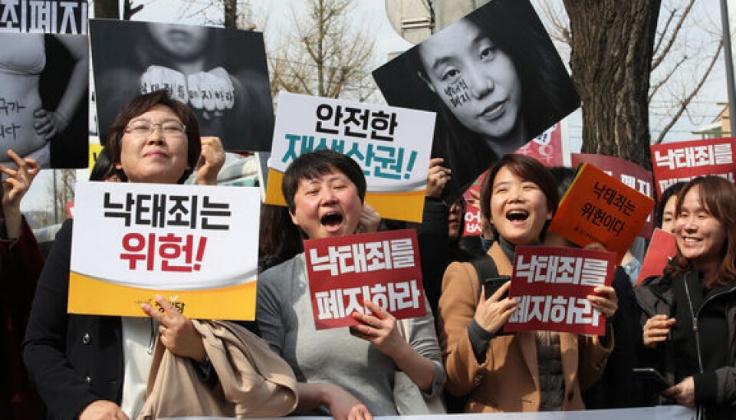
Abortion rights activists celebrate the Constitutional Court’s
decision on 11 April 2019, at the court’s gates in central Seoul.
The Constitutional Court ruled Act 269 of the current Criminal
Act, also known as the abortion law, as unconstitutional for the
first time in 66 years./YONHAP
The government is weighing a certification system that would allow doctors outside of obstetrics and gynaecology specialties to prescribe abortion pills ahead of the medication’s planned 2027 rollout.
The government is considering allowing doctors other than OB-GYN specialists to prescribe abortion pills if they complete required training and receive certification. The medication is expected to be introduced in the first quarter of 2027.
The Ministry of Health and Welfare and the Korean Society of Obstetrics and Gynecology (KSOG) are discussing creating a training and certification system run by a separate accreditation body for doctors who want to prescribe the medication.
If the plan is adopted, doctors who are not OB-GYN specialists could prescribe abortion pills after completing the required training and demonstrating the necessary clinical skills, including the ability to rule out an ectopic pregnancy.
Medical groups had previously argued that prescribing and dispensing abortion pills should be restricted to OB-GYN specialists. Talks with the government, however, have moved toward allowing doctors to qualify based on their clinical competency rather than their specialty alone.
“We are discussing with the medical community a system that would not limit prescribing eligibility to OB-GYN specialists,” a government source said.
The government formally announced plans to introduce abortion pills in September. It also proposed that doctors at medical institutions handle both prescribing and dispensing during the first two years after their introduction.
“The criteria will be reviewed again after two years,” Dr. Lee Jae-kwan, chair of the KSOG and a professor of obstetrics and gynaecology at Korea University Guro Hospital, said.
Expanding the pool of eligible prescribers could also improve access in areas with few OB-GYN specialists. There are 22 municipalities nationwide that don’t have any OB-GYN clinic at all, according to data released by the ruling Democratic Party lawmaker Rep. Nam In-soon during an audit of the National Assembly Health and Welfare Committee in October. And another 33 municipalities have only one OB-GYN clinic.
Questions remain, however, over what examinations should be required before abortion pills are prescribed. The KSOG has proposed the ability to interpret ultrasound scans as a key competency for doctors prescribing the medication. “Confirming gestational age and making sure an ectopic pregnancy is not missed are important safety measures, but that does not mean every patient must undergo an ultrasound,” the Korean Federation of Medical Activist Groups for Health Rights said in a statement on Wednesday.
The World Health Organization and relevant U.S. medical societies recommend ultrasound examinations when medically necessary, such as when gestational age is uncertain, the group said.
Work on prescribing guidelines has also been slow.
The government said in September that it would consult the medical community on standard clinical guidelines, but detailed guidance has yet to be drawn up because the Ministry of Food and Drug Safety has not completed the product approval process for abortion pills.
“We need to refer to the details of the Drug Ministry’s product approval before drawing up prescribing guidelines,” a Health Ministry official said. The Drug Ministry, however, has offered little detail beyond its target timeline. “We are preparing for approval with the goal of introducing the medication in the first quarter of next year,” the Drug Ministry said.
SOURCE: Korea JoongAng Daily, by News Team [by CHAE HYE-SEON, YANG SU-MIN [lee.jiwon10@joongang.co.kr], 2 November 2026.