


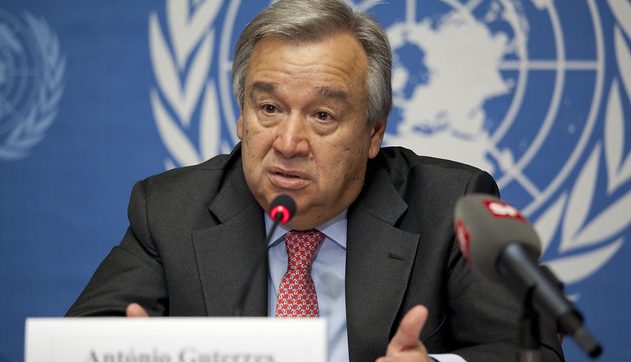
Remarks of the UN Secretary General António Guterres to a United Nations Association UK meeting, celebrating the 80th anniversary of the UN General Assembly, in London, 17 January 2026 – exactly 80 years to the day after the UNA was launched in the same room at Central Hall Westminster in the UK Parliament building, with 2,000 people in attendance.
UN Secretary-General’s remarks to the United Nations Association of the United Kingdom on the 80th Anniversary of the General Assembly [as delivered, but not the full text]
Statement | António Guterres, Secretary-General, 17 January 2026
Excellencies,
Dear friends,
It is an honour to join the United Nations Association of the United Kingdom to mark this special anniversary.
Let me begin with my profound gratitude.
Gratitude to the United Kingdom for its decisive role in creating the United Nations.
And, even more, gratitude for being such a strong pillar of multilateralism and champion of the United Nations today.
The UNA-UK is a key reason why.
I salute your 80 years of advocacy, awareness raising and unwavering commitment to keeping the United Kingdom global.
My thanks to you and all the members of civil society here today for showing up for the UN – and for honouring history with your eyes firmly fixed on the future.
We need you more than ever.
Dear friends,
We are here to celebrate “UNGA at 80” — when delegates from 51 countries came together in this Hall for the very first session of the General Assembly.
We also mark another moment — exactly 80 years ago today — when the Security Council met for the first time.
To reach this Hall, delegates had to pass through a city scarred by war.
Buckingham Palace, Westminster Abbey, and the House of Commons had been shelled by the Luftwaffe.
And as those bombs fell, terrified civilians huddled here, in the basement of the Methodist Central Hall — one of the largest public air-raid shelters in London.
Throughout the Blitz, as many as 2,000 people gathered here for safety, hoping beyond hope that this building would last the night.
Every stone of this Hall is suffused with the wishes and prayers, sometimes desperate, of ordinary people — for peace.
It was just above that shelter, where so many sought protection, that the nations of the world met to “save succeeding generations from the scourge of war”.
In many ways, this Hall is a physical representation of what the United Nations is: a place people put their faith — for peace, for security, for a better life.
The General Assembly is at the heart of that work.
Down the road from here is the “Mother of Parliaments”.
The General Assembly is the parliament of the family of nations.
It is a forum for every voice to be heard, a crucible for consensus, and a beacon for cooperation.
The first General Assembly resolution – adopted just days after the first meeting – focused on disarmament and the elimination of atomic weapons as a global goal.
And for eight decades, the General Assembly has been the place the world comes together to help advance peace, promote sustainable development, and safeguard human rights.
By its nature, the work of the General Assembly may not always be straightforward or seamless.
But it is a mirror of our world, its divisions and its hopes.
And it is the stage on which our shared story plays out.
Today, we are entering a new chapter of that story.
Dear friends,
In my first year as Secretary-General, I stood in this very place to address the UNA-UK.
It was 2017, in the wake of elections and referenda that shook societies around the globe.
I spoke of risks we faced:
Local conflicts becoming regional;
New technologies, including artificial intelligence, threatening to profoundly disrupt economies;
National sovereignty being invoked as a pretext to undermine human rights.
Over the last decade, all of this and more has unfolded at warp speed.
The conflicts in Gaza, Ukraine and Sudan have been vicious and cruel beyond measure;
Artificial intelligence has become ubiquitous almost overnight;
And the pandemic poured accelerant on the fires of nationalism — stalling progress on development and climate action.
If this period has taught us anything, it is that our challenges are ever more borderless, and ever more interconnected.
The only way to address them is together.
And that requires a robust, responsive and well-resourced multilateral system.
Yet as we speak, that system is under threat.
2025 was a profoundly challenging year for international cooperation and the values of the UN.
Aid was slashed.
Inequalities widened.
Climate chaos accelerated.
International law was trampled.
Crackdowns on civil society intensified.
Journalists were killed with impunity.
And United Nations staff were repeatedly threatened — or killed — in the line of duty.
At the same time, we see powerful forces lining up to undermine global cooperation.
Last year, the UN reported that global military spending reached 2.7 trillion dollars — over 200 times the UK’s current aid budget, or equivalent to over 70% of Britain’s entire economy.
As the planet broke heat records, fossil fuel profits continued to surge.
And in cyberspace, algorithms rewarded falsehoods, fuelled hatred, and provided authoritarians with powerful tools of control.
Yet despite these rough seas, we sail ahead.
Look no further than news of this very day.
Today, the Agreement on Marine Biological Diversity of Areas beyond National Jurisdiction comes into force.
This treaty establishes the first legal framework for the conservation and sustainable use of marine biodiversity in the two-thirds of the ocean beyond national limits.
The negotiations were a model of modern diplomacy: led by science, with the participation not just of governments, but of civil society, Indigenous Peoples and local communities.
These quiet victories of international cooperation — the wars prevented, the famine averted, the vital treaties secured — do not always make the headlines.
Yet they are real. And they matter.
If we wish to secure more such victories, we must ensure the full respect of international law and defend multilateralism, strengthening it for our times.
The world of 2026 is not the world of 1946.
As global centres of power shift, we have the potential to build a future that is either more fair — or more unstable.
If we wish to make it more fair, it is critical that the international system reflects today’s reality.
That is the spirit of our UN80 initiative and the essence of the Pact for the Future – a blueprint to ensure that the United Nations is more agile, more coordinated, and more responsive.
It is also at the centre of our drive to update the Security Council and to reform the unjust and unfair international financial architecture.
And I would add that it is manifestly in the interests of those who hold the most power to be on the frontlines of reform.
Those trying to cling to privileges today risk paying the price tomorrow.
And so we must be bold enough to change.
Bold enough to find the courage of those who came to this Hall 80 years ago to forge a better world.
The circumstances demand nothing less.
Dear Friends,
In this moment when the values of multilateralism are being chipped away, it is up to us — in our capacity as professionals, as voters, and as members of organizations like the UNA-UK — to take a stand.
More than ever, the world needs civil society movements that are fearless and persistent — that make it impossible for leaders to look away.
The General Assembly which we celebrate today exists because of a simple truth — humanity is strongest when we stand as one.
But that unity does not start in the General Assembly — it starts here, with people’s movements like yours.
FULL TEXT OF HIS TALK: https://www.un.org/sg/en/content/sg/statements/2026-01-17/secretary-generals-remarks-the-united-nations-association-of-the-united-kingdom-the-80th-anniversary-of-the-general-assembly-%28-delivered%29