


BMJ 2026; 394 doi: https://doi.org/10.1136/bmj-2026-100497 (Published 15 September 2026) Cite this as: BMJ 2026;394:e100497.
by Clarisa Bencomo, project director for gender justice; Terry McGovern, professor; Oriana López Uribe; co-executive director
For 80 years the United Nations (UN) system 1,2 has been a venue for advancing the rights of women, girls, and, over time, LGBTQ+ individuals. Its support for laws, norms, policies, and programmes to improve gender equality and sexual and reproductive health and rights (SRHR, box 1) directly contributed to global decreases in maternal mortality (40%, 2000-23) and women’s and girls’ AIDS related mortality (58%, 2010-24), and halved the lifetime risk of maternal related death (2020-23).3,4 The features that helped the UN make progress on SRHR—specialised gender equality and SRHR agencies with complementary mandates; civil society contributions to knowledge production, norm setting, and accountability; and consensus based decision making—are being undermined and those gains reversed.
Today the UN faces unprecedented crises. Member states owed a record $1.6bn in regular budget dues at the end of 2025, and by May 2026, the UN projected it would run out of money in August if member states didn’t pay up.5 Voluntary development funding is shrinking, and 2026 bilateral aid for health is projected to reach its lowest level in almost two decades, with reproductive and population health hardest hit.6 Anti-rights agendas are gaining ground. 7–8–9–10–11 Imposed austerity measures, illicit financial flows, and an emerging debt crisis make women and girls in low and middle income countries especially vulnerable.12
The UN secretary general’s solution to this moment is UN80, a rushed package of restructuring and programmatic cuts. Within UN80, the merger of the UN’s lead gender equality and SRHR agencies, UN Women and the UN Population Fund (UNFPA), promises unverifiable cost savings while risking global norms and institutions developed over decades.13 In this article, part of a BMJ collection exploring how to protect SRHR from the effects of shifts in the multilateral system, we argue that this is the wrong approach and call for the secretary general to listen to the demands of member states and progressive civil society for greater transparency and consideration of less risky alternatives.
Box 1
Terminology
- Multilateralism refers to the institutions, rules, and policies organising cooperation among nations to achieve shared goals. The UN and its affiliate entities comprise the largest multilateral system currently in existence.
- Sexual and reproductive health is a state of complete physical, mental and social wellbeing, in all matters relating to the reproductive system and functions and processes. Reproductive health implies that people are able to have a satisfying and informed sex life and that they have the capability to reproduce and the freedom to decide if, when, and how often to do so. (World Health Organization)
- Sexual and reproductive rights are grounded in fundamental human rights guarantees, including the rights to life, health, privacy, information, freedom from discrimination, and freedom from cruel, inhuman, and degrading treatment, among others. The Committee on Economic, Social and Cultural Rights highlights the deep impact of social determinants on realisation of the right to sexual and reproductive rights and state parties’ obligation to “move as expeditiously and effectively as possible towards the full realisation of the highest attainable standard of sexual and reproductive health … using all appropriate means, particularly including, but not limited to, the adoption of legislative and budgetary measures.” (Committee on Economic, Social and Cultural Rights General Comment 22)
- Gender mainstreaming is the process of assessing the implications for women and men of any planned action, including legislation, policies, or programmes, in all areas and at all levels. It is a strategy for making women’s as well as men’s concerns and experiences an integral dimension of the design, implementation, monitoring, and evaluation of policies and programmes in all political, economic, and societal spheres so that women and men benefit equally and inequality is not perpetuated. (Agreed conclusions of the UN Economic and Social Council, A/52/3, 18 September 1997)
- A treaty reservation is a unilateral statement made by a state when signing, ratifying, accepting, approving, or acceding to a treaty, whereby it purports to exclude or to modify the legal effect of certain provisions of the treaty in their application to that state. The reservation is impermissible if prohibited by the treaty or is incompatible with the object and purpose of the treaty. (Vienna Convention on Treaties)
Institutionalising women’s rights as human rights
The UN was established after the second world war to maintain international peace and security and harmonise international human rights and development cooperation. Now grown from 51 to 193 member states, its general assembly sets policies and member state dues, elects non-permanent security council members, and appoints the secretary general, who oversees day-to-day administration of 35 000 staff and a $69bn system-wide budget. Decisive power remains concentrated among the security council’s five permanent members, each holding veto power on all substantive issues.
Historically, most general assembly resolutions are adopted by consensus, which leads to resolutions on contentious issues being weakened during negotiations. Anti-rights agendas have sought to undermine human rights resolutions and commitments by redefining rights concepts such as “family,” “women,” “gender,” and limiting the scope of human rights institutions, funding, and accountability mechanisms. As a result, these rights functions rely heavily on voluntary, often earmarked, funding: UNFPA (100%), UN Women (97.7% in 2024), Office of the High Commissioner for Human Rights (57.4% in 2025), UNAIDS (100%).
This gives member states with permanent security council seats and those with enough resources to make voluntary contributions outsized leverage over budgets and policies throughout the UN system. Although progressive agendas have provided funding and advocated for institutionalisation of national and multilateral human rights norms, without addressing the unbalanced power dynamics the gender architecture remains vulnerable to regression.(9 11)
Embedding SRHR in human rights norms and mechanisms
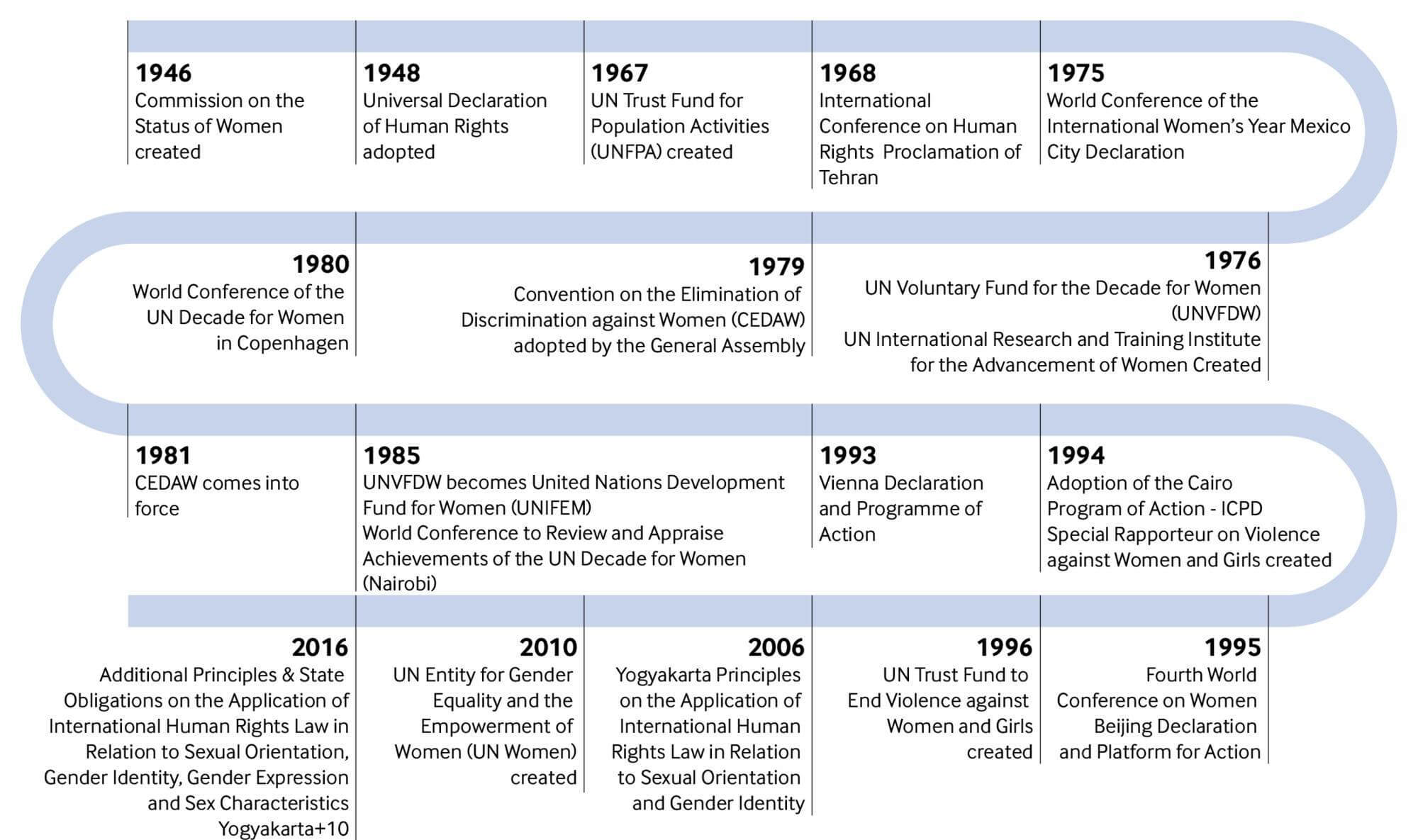
The UN charter upholds human dignity and men’s and women’s equal rights and tasks the general assembly with assisting in the realisation of human rights and fundamental freedoms—including the right to health—“without distinction as to race, sex, language, or religion.”(14) The general assembly exercises this role through subsidiary organs, initially the Economic and Social Council, Commission on Human Rights (succeeded by the Human Rights Council in 2006), the Commission on the Status of Women (CSW), and later, specialised women’s rights and SRHR agencies UNFPA (1967) and UN Women (2010) (fig 1).
Figure 1.
CSW and UNFPA’s specialised technical expertise, knowledge production, and advocacy would directly shape multilateral norm setting processes, treaties, and national laws and policies. CSW annual meetings provided a venue for likeminded member states and feminist civil society organisations to share information, strategise, and build support for formalising women’s rights within the UN and international law. CSW staff led the creation and near universal adoption of the first comprehensive and internationally binding treaty on women’s rights, the Convention on the Elimination of All Forms of Discrimination Against Women.
With 22 of its 23 current independent experts being women, the convention’s committee is the UN’s largest and most representative of women. As of June 2026, it had adopted 40 authoritative general recommendations clarifying the convention’s intent and state parties’ obligations, including providing examples of SRHR violations that constitute forms of gender based violence and may constitute torture or cruel, inhuman, or degrading treatment.15,16 A draft general recommendation on gender stereotypes is under review.
Feminist civil society organisations’ advocacy for inclusion of sexual orientation and gender identity in the 1995 Beijing Platform of Action (see below) marked the UN’s first open discussion of LGBTQ+ issues; it failed under pressure for consensus during late night closed door government negotiations.17 Subsequent efforts to affirm gender diversity have been under fierce attack, and first detailed explication of the applicability of international human rights standards to lesbian, bisexual, transgender, nonbinary, and intersex women, the Yogyakarta Principles, were produced by civil society organisations outside UN auspices.18,19
Mobilising support for institutional and structural change
Today’s progress on gender equality and SRHR reflects decades of institution building, norm development, and sustained advocacy and knowledge production. Progressive civil society organisations contributed analysis, advised national governments, and produced language for government commitments.11 Four UN conferences highlight the magnitude of these contributions and their vulnerability as the multilateral system comes under greater pressure.
CSW organised the 1975 World Conference of the International Women’s Year, with 1200 delegates representing 133 governments, and over 5000 participants attended a parallel civil society tribune. The conference and tribune launched strategic relations, networks, and non-governmental organisations that would shape transnational and national feminist activism for decades.17 CSW resolved political disagreements between northern and newly independent countries by splitting the aspirational conference declaration from the more technical World Plan of Action. The declaration passed by recorded vote with most northern countries abstaining, while the World Plan of Action passed by consensus. The plan set national and regional action plans to integrate women in development—including SRHR—that were institutionalised in new national government agencies and bilateral development aid programmes, and resulted in a UN Decade for Women and the creation of the UN Development Fund for Women and the International Research and Training Institute for the Advancement of Women, two precursors to UN Women. The institute trained a generation of women who would lead their developing countries’ new institutions, while the UN Development Fund for Women provided funding.20
The 1993 world conference on human rights’ Vienna Declaration and Programme of Action demonstrates the impact of this institutionalisation and networking on broader human rights norms. It affirms women’s right to the highest standards of physical and mental health throughout their lifespan and state responsibility to tackle violence in the private sphere and harmful customary, cultural, and religious practices. Its call for gender mainstreaming in strengthened UN human rights mechanisms contributed to the appointment of a high commissioner for human rights and a special rapporteur on violence against women.21
The 1994 international conference on population and development’s Cairo Programme of Action reframed discussions of SRHR and development. The general assembly invited formal non-governmental organisation participation, and under UNFPA leadership progressive civil society organisations were included in preparatory conferences and had direct engagement with governments. Despite intense efforts by the Vatican to exclude SRHR language, the conference produced a 20 year agenda advancing reproductive health as “a state of complete physical, mental, and social wellbeing and not merely the absence of disease or infirmity,” and promoting gender equality through ensuring women’s and girls’ access to abortion care, family planning, HIV/AIDS prevention and treatment, and sexuality education.22
The 1995 Beijing Declaration and Platform for Action from the fourth world conference on women added a diagnosis of structural drivers and barriers to women’s rights and wellbeing across 12 critical areas of concern, set concrete goals for health system reforms, and provided guidance on integrated measures that UN bodies, national and regional governments and bodies, and civil society organisations should take to ensure the full range of women’s rights.23 Recognising a need for better data and accountability, the Economic and Social Council expanded CSW’s mandate to monitoring and reviewing the implementation of the Platform for Action and mainstreaming a gender perspective in UN activities. In 2002 it established a special rapporteur on the right of everyone to the enjoyment of the highest attainable standard of physical and mental health.24
Post-Cairo and Beijing anti-rights organising accelerated and spread, and CSW and UNFPA conference follow-up processes were venues for organising progressive civil society, as described elsewhere in the collection.9,11 In 2008, 300 progressive civil society organisations coordinated with likeminded UN insiders and member states to launch the Gender Equality Architecture campaign (GEAR).17 GEAR proposed merging four small UN entities into a unified and well-funded gender equality agency. In 2010 the general assembly mandated the new entity, UN Women, to coordinate the UN’s gender equality work, support the norm setting work of CSW and other intergovernmental bodies and provide technical and financial support to member states in implementing gender equality initiatives. The general assembly funded its internal norm setting activities, but UN Women would need to fundraise to expand its offices, staff, and external work.
System-wide challenges
The UN system has long suffered from internal fragmentation, lack of accountability to the populations it serves, and inequitable power and authority between agencies and between member states. Its reliance on voluntary contributions for many mandated human rights functions incentivises inter-agency competition and leaves this work chronically underfunded, siloed, hidden, and dependent on private philanthropy. As transnational anti-rights agendas grow more powerful, the combined impact of these weaknesses makes the multilateral system increasingly susceptible to their efforts to undermine SRHR.9,11,12
Fragmentation and limited accountability for gender mainstreaming
The UN governance and funding model creates a sprawling system of competing agencies vulnerable to manipulation by powerful and rich member states. Previously, strong leadership within the secretariat and specialised SRHR and human rights institutions together with pressure from civil society provided a counterweight to those tensions. The system-wide action plan on gender equality and women’s empowerment shows how low gender mainstreaming is in the current secretariat’s priorities. Launched in 2012, by 2024 only 56% of UN entities reporting had set a gender-related financial benchmark and only 36% met or exceeded that benchmark. Fewer than half of country teams met or exceeded minimum requirements for tracking and allocation of financial resources towards achieving gender equality.25
Under-resourced human rights mechanisms
Powerful member states may use politicised and opaque budgetary processes to constrain human rights activities.26 In the current crises, additional cuts to the Office of the High Commissioner for Human Rights have required it to postpone mandated activities, lay off staff, and close offices, deeply affecting the work of the Human Rights Council and the special procedures independent experts who issue authoritative findings on states’ compliance with human rights obligations on gender and SRHR.27
Weak mechanisms to enforce human rights commitments
Human rights mechanisms issue findings, rulings, and recommendations and provide technical support to governments and victims, but member states are the ultimate accountability mechanism. More states have made reservations to provisions of the Convention on the Elimination of All Forms of Discrimination Against Women than any other human rights treaty, with many citing customary, religious, and traditional law or practice to improperly justify harmful practices. For example, Niger asserted that equality in marriage and decisions around the number and spacing of children were contrary to existing customs and practices and so could not be abolished by law, but only evolve over time.28 The Convention on the Elimination of All Forms of Discrimination Against Women committee has repeatedly stated that these reservations are impermissible and called for their withdrawal.29
Currently, there are few incentives for member states, alone or jointly, to hold other states and non-state actors accountable. Another article in the collection suggests ways that could change.12
UN80: the wrong answer to the wrong question
In the past, strong leaders in specialised SRHR, gender, and human rights institutions worked closely with progressive civil society and member states to mitigate the effect of these systemic challenges on gender equality and SRHR. The secretariat led UN80 has largely shut these civil society organisations and member states out of its process.
The proposed UNFPA-UN merger creates an especially high risk because it requires a general assembly resolution that, once introduced, could be amended to limit or even end both agencies’ work. Additionally, general assembly resolutions and other important decisions are often adopted by consensus, encouraging backroom negotiations where powerful countries can, with impunity, dilute or block gender equality and SRHR language before a resolution reaches the assembly. Often invisible to outsiders, the 2026 CSW Agreed Conclusions demonstrates this approach. Before the meeting the US pressured the CSW chair, co-facilitators, and member states to accept its “redlines” and weaken or erase gender and SRHR language rooted in the Cairo and Beijing declarations, and it later introduced eight resolutions with the same goal, prompting extensive civil society organisations’ advocacy with member states and eventually, the first recorded vote in 70 years.30,31 Notably, several states who agree with, or have been pressured by, the US abstained from voting on the resolutions, signalling their discomfort with disruption of consensus based processes and the strength of progressive civil society organisations’ advocacy.
Independent cost-benefit analysis and consultations with country level government, UN, and civil society stakeholders demonstrate that the secretariat’s arguments for a UNFPA-UN Women merger do not hold up and lack viable plans to mitigate higher costs, funding shortfalls, and the massive disruptions of critical SRHR and coordination systems a merger would create.13,32
Progressive civil society organisations have proposed substantive, evidence based pathways that preserve the UN’s capacity to deliver for SRHR without a merger, and strengthen its ability to address complex, interconnected challenges through shared strategic priorities, coordination for joint efforts, joint accountability mechanisms, and formal engagement with civil society organisations and affected communities.33
Priorities for reform
The current crises and the secretary general’s UN80 process make clear that protecting SRHR and other rights from regression requires deep transformation of the UN’s funding and administrative structures to reduce power imbalances between states and private actors, and increase meaningful participation by the communities the UN serves (Box 2). Fully achieving this transformation will require strong and sustained leadership, organising, and advocacy by progressive governments and civil society at UN, national, and local levels. As this collection demonstrates, feminist civil society organisations and movements are uniquely positioned to contribute their deep expertise and decades of experience working with governments and specialised gender equality, SRHR, and human rights institutions to this effort.
Box 2
Priorities for UN structural reforms to advance SRHR
This is a partial list of feminist civil society demands often raised during the UN80 process. Several, like security council reforms, have the support of some member states. Aspects of many of these reforms, such as UNAIDS’ pooled funding and formal civil society participation, have been tested at smaller scale and need to be more broadly adopted and institutionalised with effective, accountable, and fully funded mechanisms.
–Strengthen the general assembly as the central body for deliberation, oversight, priority setting.
–Challenge the archaic permanent seats at the security council and their veto power to start a structural transformation that could create a more horizontal platform for all member states.
–Expand centralised pooled funding and budget allocations aligned with priorities collectively agreed on at the general assembly.
–Assess thoroughly the contributions and effectiveness of UN entities before proposing their mergers, closures, cutbacks, or sunsetting.
–Address fragmentation through coordination and updated ways of working keeping technical specialisation.
–Protect normative and human rights functions in advancing rights and accountability.
–Apply an equity lens to administrative structures. Review and transform administrative costs, expatriation packages, headquarters locations, salary scales, geographical staff distribution, and benefits that perpetuate north-south inequalities.
–Engage networks and coalitions of feminist civil society organisations for their deep expertise on implementation of SRHR through formal participation in governance mechanisms.
Conclusion
The measure of successful multilateral reform should be greater access to rights, effective crisis responses, better coverage of excluded populations, improved interagency coordination, greater financial stability, and increased trust from states and civil society. The current UN crises create unprecedented risks to SRHR and gender equality, but also unprecedented opportunities for member states and feminist civil society together to advance much needed structural reforms to the multilateral human rights and gender architecture.
Key messages
– The UN’s gender equality and sexual and reproductive health and rights (SRHR) institutions, in partnership with progressive member states and civil society, have significantly advanced global health, gender equality, and sustainable development
– The UN is under unprecedented financial and political stress and transnational anti-rights forces are exploiting weaknesses in the UN governance system to undermine gender equality and SRHR institutions, norms, and mechanisms
– The UN80 reform initiative and its proposed merger of the UN Population Fund and UN Women fail to address the most urgent priorities for UN reform while creating irreversible risks to the lives, health, and wellbeing of women and girls
– The reform creates an opportunity for member states and progressive civil society to prioritise structural transformation of the UN’s funding and administrative structures to reduce power imbalances between states and private actors and increase meaningful participation by the communities the UN serves
Acknowledgments by the co-authors
We thank the many courageous feminist actors and movements around the world who succeeded in embedding and expanding gender equality and sexual and reproductive rights and health in national and multilateral institutions and spaces despite tremendous opposition. Their past, present, and future work to achieve a world where everyone enjoys the highest level of health and rights is an inspiration and call to action for us all.
References and other information can be found at the end of this article in the BMJ at: https://www.bmj.com/content/394/bmj-2026-100497 Or see: https://www.bmj.com/collections/SRHR
[The bottom line of this set of articles and comments about the future of the United Nations, is that in spite of the financial problems it is going through and the refusal of so many rightwing national leaders to support the UN, as well as human rights and women’s sexual and reproductive health and rights, is that it would be a terrible mistake to combine UNFPA and UN Women in order to save money. Editor]