


Background
Resolution 2286, which was unanimously adopted in May 2016, remains the Security Council’s only stand-alone resolution on the protection of medical care in armed conflict. It was co-penned by five elected members—Egypt, Japan, New Zealand, Spain, and Uruguay—a configuration that was notable at the time for its regional diversity and for being a departure from the then-standard practice of permanent members France, the UK, and the US (known as the “P3”) holding the pen on most resolutions. The text strongly condemned acts of violence, attacks and threats against the wounded and sick, medical personnel and humanitarian personnel exclusively engaged in medical duties, their means of transport and equipment, and hospitals and other medical facilities, and demanded that all parties to armed conflict comply with their obligations under international humanitarian law (IHL) and international human rights law (IHRL) to ensure their respect and protection. It also demanded that parties to conflict facilitate safe and unimpeded passage for personnel exclusively engaged in medical duties and underscored the importance of bringing to justice those who violate IHL, “as provided for by national laws and obligations under international law”.
Additionally, the resolution established new reporting requirements for the UN Secretary-General, requesting him to include information on attacks against medical care in conflict in his country-specific reports and other relevant reports which address the protection of civilians (PoC). It also requested him to submit recommendations on measures to prevent such attacks. Those recommendations, transmitted to the Council on 18 August 2016, proposed 13 measures across three areas: reinforcing a framework of respect for and protection of medical care; enhancing operational protection through precautionary measures; and strengthening documentation, accountability, and redress.
Since the adoption of resolution 2286, attacks on medical care in conflict have not only persisted but surged. In 2017, the SHCC documented 660 incidents of violence against medical care, which killed 160 medical personnel. According to the organisation’s most recent annual report, there were 3,623 incidents in 2024—the highest number ever recorded, representing a 15 percent increase from 2023 and a 62 percent rise from 2022—which resulted in the deaths of 927 health care workers. The increase was driven by intense and persistent violence in Gaza, Lebanon, Myanmar, Sudan, and Ukraine, with over 80 percent of incidents attributed to state actors. The SHCC also documented a sharp rise in the use of explosive weapons, particularly drone-delivered explosives, the latter of which nearly quadrupled in 2024 compared with 2023. According to the SHCC’s currently available data for 2025, the frequency of incidents decreased somewhat last year, during which the organisation recorded 2,658 attacks on medical care and 473 health worker casualties. Overall, since the adoption of resolution 2286 ten years ago, the SHCC has documented 18,345 attacks and 3,806 deaths.
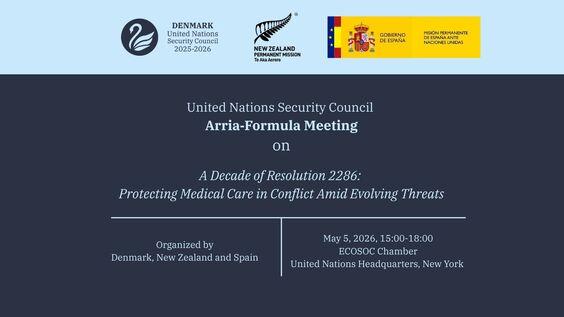
UN Security Council Arria-Formula Meeting organized by Denmark, New Zealand and Spain. To provide an informal space for the Security Council and the wider UN membership to reflect on the implementation of the resolution, key developments, and emergent threats and opportunities to the protection of medical mission in armed conflict since 2016.
The whole UN Security Council, or rather, all the many members who spoke, supported action to hold to account every warring country and every government and military who violated the international humanitarian law they had passed ten years ago and which had been violated again and again and again in the past ten years, with the numbers of violations against health care and health care providers and hospitals rising with every year that has passed. They all called for the violations to stop, but no one proposed how they were going to stop it. Had no one thought about it or had no one come up with a solution, or unified action?? I don’t know. But I won’t tell you how it ended. It was so worth watching and feeling so good about it and feeling pride in so many of the country representatives who spoke, many from experience of war and violence, especially the representative from Syria. Also one of the earliest speakers, a woman from Medecins sans Frontieres. And many others representing their countries. Well worth listening to.
The representative from Denmark opened the meeting by stating that since 2016, almost exactly a decade ago this week. There have been over 18,000 attacks on health care systems during wars, over 5,000 hospitals and clinics destroyed, and at least 3,856 health workers have been killed internationally. This meeting, she said, was not a celebration. Many speakers during the session pointed to the gross violation of international humanitarian law that this represents.
A report entitled Epidemic of Violence: Violence against Health Care in Conflict, 2024 contains fact sheets about conflict in the following countries: Africa: Sudan, Democratic Republic of the Congo, Ethiopia, Cameroon, Mali, Nigeria, Burkina Faso, Central African Republic, Niger, Mozambique, South Sudan; Asia: Myanmar, Pakistan, Afghanistan, India (Manipur state only); Middle East & Europe: Occupied Palestinian Territory, Lebanon, Ukraine, Syria, Yemen; and The Americas: Haiti, Mexico, Colombia.
As a statement by Len Rubenstein, Chair of the Safeguarding Health in Conflict Coalition, who also spoke in the Security Council meeting on 5 May 2026, said: “UN agencies, international organizations, NGOs, and civil society organizations must rally together to take tough action, including outreach to the International Criminal Court, to impose consequences on the perpetrators of violence. Actions must include states cutting off arms transfers to perpetrators of attacks and employing the power of universal jurisdiction to prosecute. If the laws of humanity are to be upheld and the carnage is to end, governments and all concerned citizens everywhere must find the political courage and will to act.” Did that happen yesterday in the full Security Council meeting? We need to encourage our governments to step up!!
SOURCES: Collected and edited by Marge Berer, from: A Decade of Resolution 2286: Protecting Medical Care in Conflict Amid Evolving Threats – UN Security Council Arria-Formula Meeting | UN Web TV. You can watch and listen to the whole recorded session (5+ hours) at the following weblink: https://webtv.un.org/en/asset/k1f/kifcq0qwb . This report, What’s In Blue : Security Council Report, contains further background information.