


– Most Malawians support girls’ re-enrolment after pregnancy and women’s reproductive decision making, but oppose abortion/
– Views are mixed on whether to make contraceptives available regardless of people’s age and marital status.
Malawi has made significant strides in promoting sexual and reproductive health and rights (SRHR) and improving maternal health (Ibrahim-Nyirenda, 2024; United Nations Population Fund, 2024). For example, according to the National Statistical Office (2024), modern contraceptive use increased (from 53% to 66% for married women aged 15-49) between 2016 and 2024, and maternal mortality declined from 439 to 224 deaths per 100,000 live births. The fertility rate among women aged 15-49 dropped from 4.4 to 3.7 children per woman over the same period.
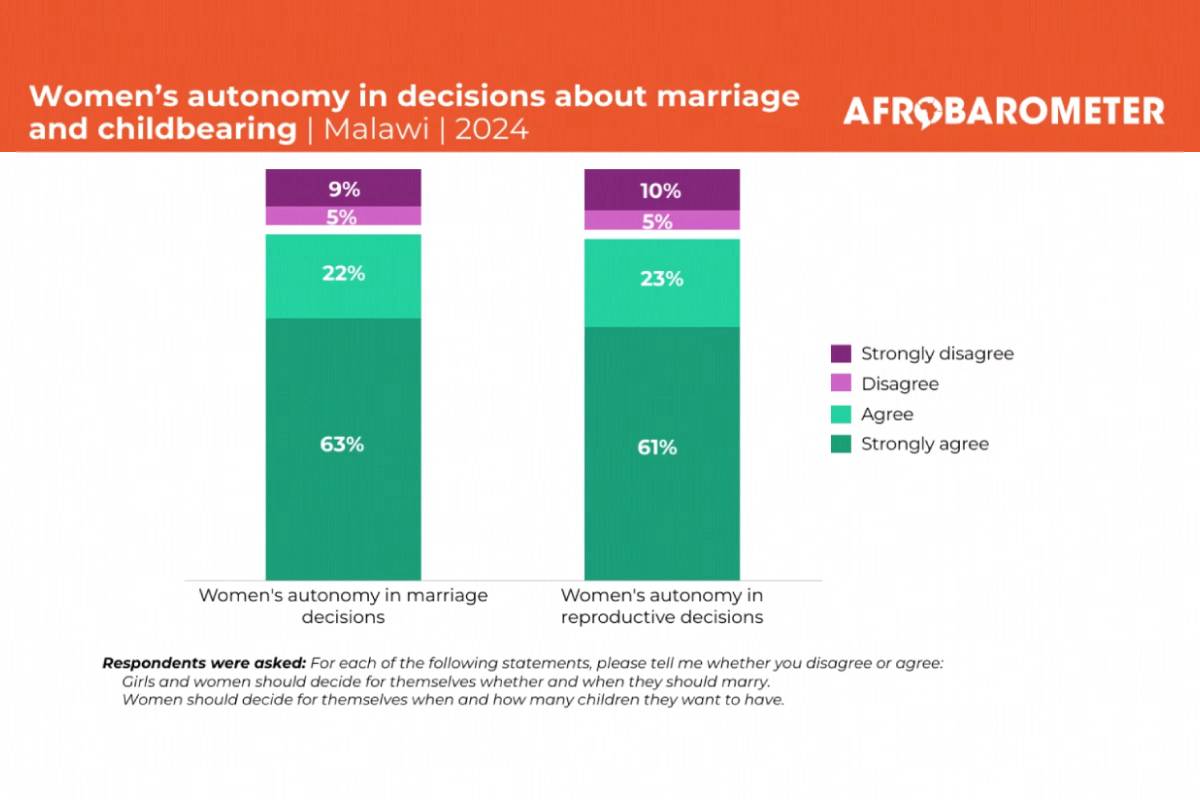
Women’s autonomy in decisions about marriage and childbearing (Malawi 2024, Afrobarometer)
Respondents were asked:
For each of the following statements please tell me whether you agree or disagree:
- Girls and women should decide for themselves whether and when they should marry.
- Women should decide for themselves when and how many children they want to have.
Despite these achievements, Malawi continues to grapple with significant SRHR issues, especially among the youth. Challenges range from early sexual debut and early marriage to gender-based violence and high rates of teenage pregnancy, school leaving, and abortion complications leading to maternal deaths (Latif, 2020). Among female and male adolescents who are sexually active, only 15% and 31%, respectively, use contraceptive methods (Alan Guttmacher Institute, 2005), and about one-third (32%) of young women aged 15-19 have had a pregnancy, an increase from 29% in 2016 (National Statistical Office, 2024).
Despite a longstanding school readmission policy allowing girls to return to school after delivery, the 2024 Malawi Education Statistics Report cites pregnancy and marriage, along with school fees, as leading reasons for high dropout rates among secondary-school students – 60% of them girls (Ministry of Education, 2024), and analysts argue that increasing the availability of contraceptives among adolescents would reduce dropouts due to pregnancy (Ibrahim-Nyirenda, 2024).
Under the 2014 Gender Equality Act, Malawian women and girls have the legal right to decide whether and when to get married, though traditional and cultural practices often play a role in marriage decisions (Mbweza, Norr, & McElmurry, 2008). More than one in three Malawian women aged 20-24 (37.7%) were married before the age of 18 (National Statistical Office, 2021).
Termination of pregnancy is illegal unless the life of the woman is in danger, and violations are punishable by a jail term of up to 14 years (African Population and Health Research Centre, 2023). Despite advocacy for broadening the criteria to include cases of rape, incest, or harm to the woman’s well-being (Southern Africa Litigation Centre, 2021), a bill proposing to expand legal justifications twice failed to be tabled in Parliament, in 2016 and 2021. But in a landmark ruling last October, the High Court said that adolescent survivors of sexual violence have a right to access abortion services in public and private health facilities (Ipas, 2025). Religious groups have said they will appeal the ruling (Pansungwi, 2025).
A special module in Afrobarometer’s 2024 survey in Malawi explores citizens’ opinions and experiences related to sexual and reproductive health and rights. Findings show that Malawians overwhelmingly support women’s autonomy in decisions about marriage and childbearing. They also strongly support allowing girls who become pregnant to continue their education, as well as the teaching of sexuality education in school.
But views on unrestricted access to contraceptives are mixed: More than half of adults favour making them available regardless of marital status, but not regardless of age. And majorities oppose abortion even if the woman’s health or life is at risk and in cases where the pregnancy is the result of rape or incest.
SOURCE: AfroBarometer, by Witness Tapani Alfonso and Dennis Samuel Chikoko/ 11 March 2026.