


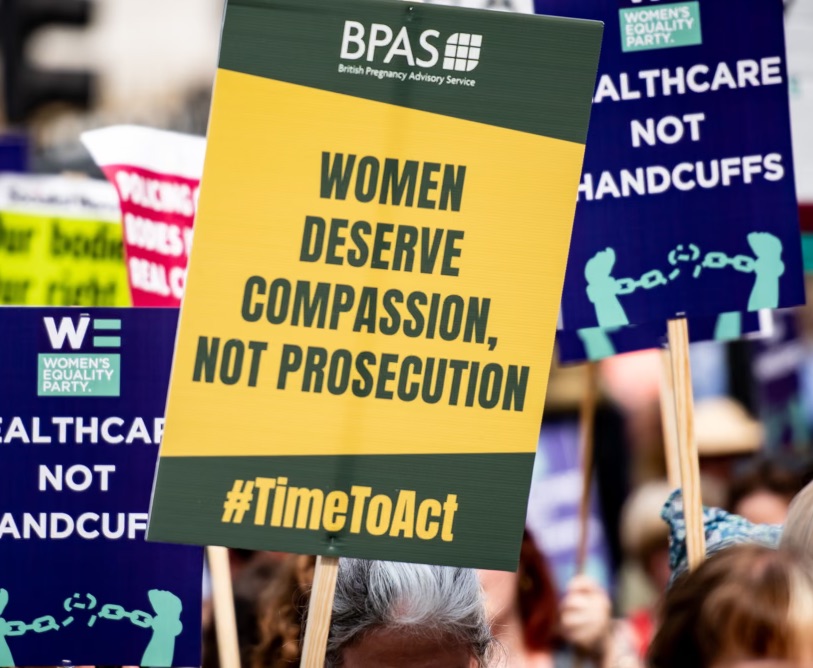
Image: From 2023 protest in London, calling for decriminalisation. Credit: Sopa Images/LightRocket/Getty Images
MPs voted last year to end the criminalisation of women who terminate pregnancies outside the legal framework. It was hailed as the biggest step forward for reproductive rights in England and Wales in six decades.
Yet it has emerged that vulnerable women in England and Wales are still being investigated and at least three women arrested over suspected illegal abortions after a vote in Parliament last June to decriminalise abortion.
The Observer reported last May that the National Police Chiefs’ Council (NPCC) , which sets strategic direction for policing in the UK, had issued new guidance on searching phones and women’s homes for abortion drugs after an unexpected pregnancy loss. At the time, senior medical professionals and abortion providers said the guidance was “truly shocking to read” and it was “fuelling a culture of hostility and suspicion towards abortion and pregnancy loss”.
According to a Freedom of Information response provided to The Observer, the day after the Commons vote last year, police chiefs met to discuss the criticism of the guidance and how officers had handled their investigations of women for illegal abortions.
An NPCC member said public criticism of the guidance, including from the Royal College of Obstetricians and Gynaecologists (RCOG), was “sensationalist”, “unhelpful” and “unfair”. They also noted that RCOG had called for the guidance to be withdrawn while the law was being actively considered by parliament.
However, the NPCC maintained the guidance was “sound” and stated it would “take no action that could be interpreted as comment upon the debate around abortion”. In response to these recent investigations of women, RCOG’s president Alison Wright, said: “The women affected in these cases are clear examples of the harmful implications of this outdated law.” “Every ongoing investigation represents a failure of compassion and a breach of women’s reproductive rights, particularly as these cases often involve women at some of the most vulnerable moments in their lives,” she added. And then this year:
1. Shock as a woman is arrested in a bereavement room after a miscarriage
One woman was arrested in the bereavement room of a labour ward after a miscarriage when she was 17 weeks pregnant. Staff claimed they alerted police to her case only because they were worried for her safety, and believed police would offer her “support”.
SOURCE: The Observer, by Phoebe Davis. 14 March 2026.
2. Responding to a freedom of information request, Nottinghamshire police and the Metropolitan police confirmed they had arrested women suspected of illegal terminations between June last year and this January.
The Observer had previously reported last May (2025) that the National Police Chiefs’ Council (NPCC) , which sets strategic direction for policing in the UK, had issued new guidance on searching phones and women’s homes for abortion drugs after an unexpected pregnancy loss. At the time, senior medical professionals and abortion providers said the guidance was “truly shocking to read” and it was “fuelling a culture of hostility and suspicion towards abortion and pregnancy loss”.
According to the Freedom of Information response provided to The Observer, the day after the Commons vote police chiefs met to discuss the criticism of the guidance and how officers had handled their investigations of women for illegal abortions.
SOURCE: The Guardian, by Hannah Al-Othman, 15 March 2026.
3. Decriminalising abortion? How might the House of Lords amend the new legislation next year?
Members of the House of Lords also put forward proposed amendments on 15 March 2026.
SOURCE: The Guardian, 15 March 2026.