



Introduction
In its programme to support women on sexual and reproductive health, ACODEFEM (Community-based Action to Support Women’s Development), with the technical and financial support of our partner, HESPERIAN Health Guides, initiated a project to strengthen the capacity of pharmacists to provide medical support for abortion. This project was implemented from April to June 2026 in the communes targeted by the project, namely the communes of Matete, Masina and Kimbanseke in the district of Tshangu, in the city province of Kinshasa, specifically in the eastern part of the city.
The project’s objectives were to:
- Train communities on safe abortion to improve access to information and reduce the risks associated with unsafe abortions.
- Promote ownership of safe abortion to preserve human lives and ensure the community is aware of misoprostol and mifepristone.
To achieve these objectives, the following strategies were implemented:
- The facilitators emphasised that entering into an active sexual life is an important but also a very difficult step for most adolescents and young people.
- On the one hand, it is necessary to reconcile the positive and promising aspects of sexuality discovery, love, sharing, with the negative aspects (fear of early pregnancy, sexually transmitted infections (STIs) and HIV/AIDS.
- Hence, the need for the Adolescent and Youth Sexual and Reproductive Health (AYSRH) programme.
Adolescence is characterized by increased contact with the opposite sex. Thus, the sexual awakening of puberty is complemented by romantic sexual experiences: for some, this marks the beginning of sexual relationships. The conditions for entering sexual life differ from one region to another. Factors influencing this entry include; social norms, faith and spirituality, tradition, the media, the widespread extension of studies but also and especially the progress made in the field of contraception and for some countries the legalization of abortion.
Numerous studies have examined the concept of adolescent fertility and noted an increase in the sexual activity of single women, and consequently, also an increase in pregnancies before marriage. Currently, women’s sexual socialization remains more controlled than men’s, and their first sexual experiences are both more often delayed and sometimes still traumatic. In sub-Saharan Africa, premarital sexuality is intense, early, unstable, involves multiple partners, and is justified in various ways, depending on the socio-economic, socio-demographic and socio-cultural characteristics of young people and their household members.
Introduction: In its program to support women on sexual and reproductive health, ACODEFEM, with the technical and financial support of our partner HESPERIAN Health Guides, initiated a project to strengthen the capacity of pharmacists to give medical support for abortion, the implementation of which took place from April to June 2026 in the municipalities targeted by the project, namely Matete, Masina and Kimbanseke in the district of Tshangu, in the city province of Kinshasa, in the east of the city.
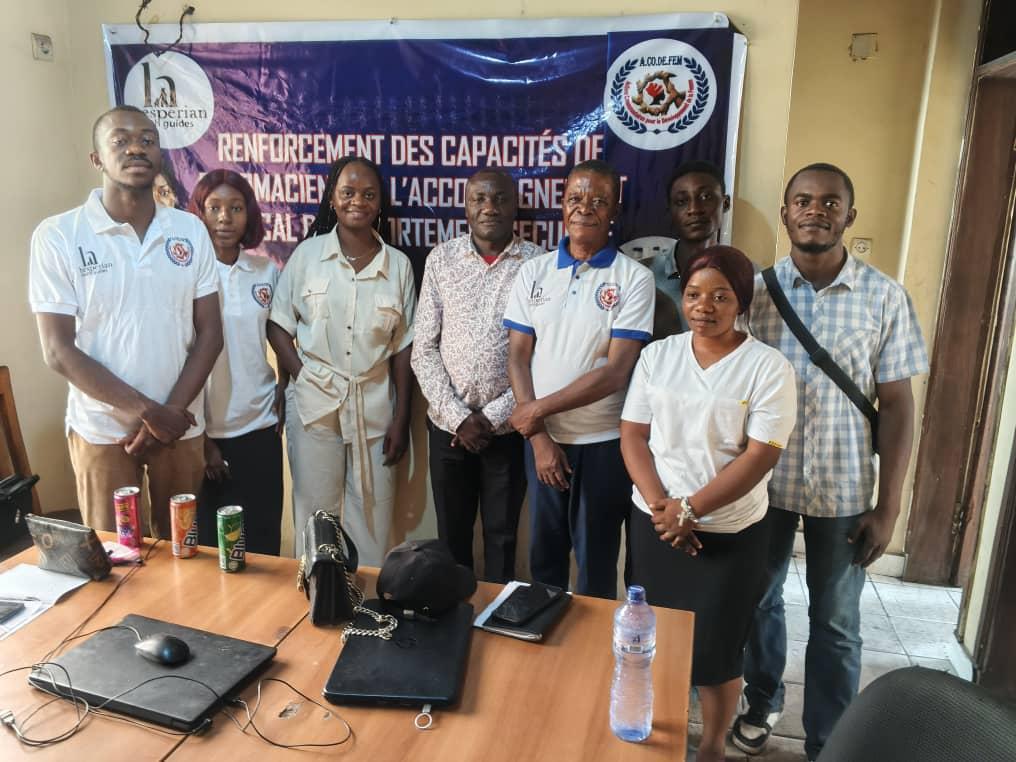
Launch of the project coordinated by the ACODEFEM team
The project objectives were:
- Training communities on self-managed abortion to improve access to information and reduce the risks of unsafe abortions, and
- Appropriation of self-managed abortion to preserve human lives and for the community to be aware of misoprostol and mifepristone products.
To achieve these objectives, the following strategies were implemented:
- The facilitators pointed out that the entry into the active sexual life of adolescents and young people represents an important but also very difficult step for most young people and adolescents. On the one hand, it is necessary to reconcile the positive and promising aspects of sexuality “discovery, love, sharing”, and on the other hand the negative aspects (“fear of early pregnancy, sexually transmitted diseases/STIs and HIV/AIDS”.
- Hence the need for the Adolescent and Youth Sexual and Reproductive Health (SRAJS) programme. Adolescence is characterized by an increase in contact with the opposite sex. Thus, in addition to the sexual awakening of puberty, there are the sexual dimensions of love, and for some it is the beginning of a sexual relationship.
The conditions for entering sexual life differ from one region to another. Factors influencing this entry include; social norms, faith and spirituality, tradition, the media, the generalized extension of studies, but also and above all, the advances made in the field of contraception and for some countries the legalization of abortion. Numerous studies have looked at the concept of adolescent fertility and have noted an increase in the sexual activity of single people and therefore in pregnancies before marriage.
Currently, women’s sexual socialization is still more controlled than that of men, and their first intercourse is both more often late and sometimes still badly experienced. In sub-Saharan Africa, premarital sexuality is intense, early, unstable, multi-partner, variously justified, depending on the socio-economic, socio-demographic and socio-cultural characteristics of young people.
It was revealed during the sensitization that in the Democratic Republic of Congo, in schools, the age group of 10-24-year-olds represents 28% of the population; and 22% of 15-year-olds have already had sexual intercourse. This rate reaches 91% by the age of 24. In Kinshasa, the capital, nearly 7 out of 10 young people or students are already sexually active by the age of 15. 88% of young students, both girls and boys, voluntarily had their first intercourse, i.e., a consenting intercourse, not rewarded in 87% of cases. It is most often unprotected sex that does not comply with the self-managed abortion strategy.
We reminded participants in sites targeted by the fact sheet, that expanding access to self-managed abortion in the Democratic Republic of Congo called for clarifications of the law. Despite these measures, access to medical and legal abortion remains very limited, in part due to:
- The inconsistent understanding and application of the law by legal institutions and law enforcement officials.
- The slow integration of the language of the Maputo Protocol into national laws.
- Severe stigmatization against female students who seek or have had an abortion. This leads to unprotected sex, unsafe abortions and often deaths.
- As a result of the feelings of girls who give themselves without conscience to each of them, they are victims of unintended pregnancy.
- In almost every country in the world, the law allows medical abortion to save the woman’s/girl’s life, and in the majority of countries, self-managed abortion is allowed to preserve her physical and/or mental health. Therefore, safe abortion services, as provided for by law, must be available and enforceable. This is the fight that the group Community Actions for the Development of Women, acronym in French ACODEFEM, carried out during the four sessions with the students in the schools targeted by the project.

Distribution of misoprostol and mifepristone pills to member pharmacies.
Key lessons with students in school settings for them to learn more about self-managed abortion. The role of self-managed, safe abortion at an early stage of pregnancy, and the fact that it is a possible solution to the challenges, is more recognized than ever. It is also an opportunity to encourage a rights-based approach to health services in the context of a school-based Voluntary Termination of Pregnancy programme. The practice of medical abortion is part of a larger abortion “ecosystem”. Let’s avoid imposing it vertically as a short-term solution.
Key terms relating to self-managed medical abortion in the DRC
This briefing focuses on the practice of self-managed medical abortion in the first three months of pregnancy (it is also referenced in the broader context of self-care innovations):
– Self-care is the ability of individuals, families and communities to promote and protect their health with or without the support of a health professional. Effective and safe self-management in connection with health systems has the potential to improve patient health.
– Self-managed abortion refers to an abortion carried out by taking pharmacological substances – known as medical abortion (MA) pills – (either by administering a combination of mifepristone and misoprostol, or by taking misoprostol alone), whether the young woman manages the process as much as possible on her own or whether a healthcare professional of her choice is involved in the process.
This briefing concerns the practice of self-managed MA during the first three months of pregnancy, from the beginning of pregnancy.
Why guarantee access in connection with healthcare facilities
Promoting and expanding access to self-managed MA may be a pragmatic alternative for SRH patients’ rights programmes that strive to mitigate the impact of safe abortion services in both school and public settings. With regard to the programmes still in the process of adapting to self-managed MA pills, the ACODEFEM team said that it is critical that patients be connected to existing health facilities to support an approach that is based on respect for patients’ rights.
What are the skills or role of pharmaceutical personnel in the field of medical abortion? In this context, where the capacity of formal health services is limited, pharmacies can play an important role in the provision of abortion medications to patients. In addition, simple measures to allow delivery to pharmacies can accompany the delivery of health products, despite the fact that the products dispensed by these pharmacies are insignificant. Other measures may be needed to strengthen this circuit. The provision of services by pharmacists should therefore be seen as part of a range of interventions within a wider enabling ‘ecosystem’ – e.g. convenient labelling of health products, proper display of hotlines; digital platforms and community health networks can also be used to support women seeking self-managed MA.
Why also target specific post-abortion care (PAC) services for young people? Young people are more vulnerable to unwanted pregnancies; Nearly half of the stigma and deaths associated with unsafe abortion occur in girls under the age of 18. Young girls face many barriers to accessing PAC services (lack of knowledge about PAC services, inability to pay clinic fees and attend during clinic hours).
Highlights of these activities
Active participation of the students from the 3rd to 6th grades of the humanities was remarkably good. Exchange is also needed between girls and boys about the consequences of stigmatization of girls who have had unsafe abortions and the importance of the use of abortion pills and their safety, i.e. mifepristone and misoprostol.
Follow-up thoughts
An important weakness was that our very limited funds did not allow us to increase the number of schools that requested the training.
Recommendations
There were three requests from the direct beneficiaries of the medical abortion pill services:
– Expand the Project on Access to Medical and Safe Abortion in the DRC;
– That the ACODEFEM reproduce and multiply the module on the Maputo law;
– That the Government assist NGOs in carrying out their activities on self-managed abortion.
SOURCE: ACODEFEM, Kinshasa, 21 February 2026. Translated from French by the authors.