


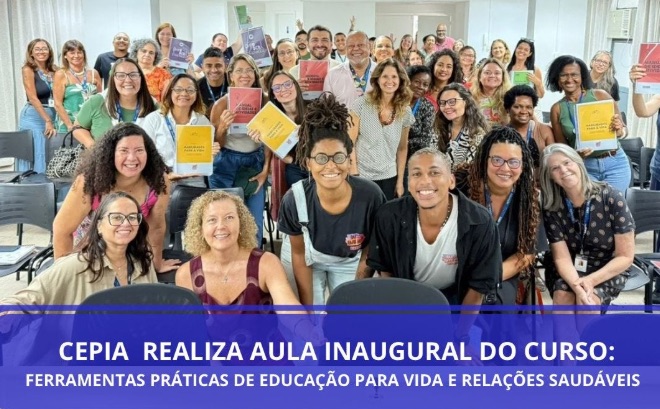
LAUNCH: COURSE ON PRACTICAL TOOLS FOR LIFE EDUCATION AND HEALTHY RELATIONSHIPS
The opening class of the Practical Tools for Life Education and Healthy Relationships Course took place on February 25th at the Municipal Education Council. The meeting, which brought together around 50 education professionals, marked the beginning of the course, which will be developed throughout February to April through a series of video lessons, synchronous sessions, and in-person meetings based on manuals produced by CEPIA for activities with adolescents and youth. The course is another result of the partnership between CEPIA and the Municipal Department of Education through the Health in School Program. Access more here on Instagram.
THE JUDICIARY DOES NOT GUARANTEE AFFECTION
On 21st January 2026, the newspaper O Globo published the article The judiciary does not guarantee affection, written by Mariana Barsted and Rachel Serodio. In the text, the authors reflect on the limits of the justice system’s role in family relationships, discussing how judicial decisions can recognise rights and establish duties, but are not capable of producing or imposing emotional bonds. The article takes a critical look at the role of the judiciary in family conflicts, highlighting the importance of understanding the dynamics of care, responsibility, and affection beyond the legal response. The reflection engages with contemporary debates on family law and the agenda for promoting gender equality and family diversity.
SEXUAL AUTONOMY PROGRAM HOLDS MEETING TO COORDINATE BETWEEN ORGANISATIONS
In January and February, the organisations that are part of the Sexual Autonomy Program, a project supported by the Elas+ Fund, participated in a coordination and dialogue meeting. The purpose of the meeting was to assess the progress of the programme and align the activities and strategies planned for 2026, strengthening joint action in defence of sexual autonomy and the rights of girls and women. Mariana Barsted and Karla Oldane represent CEPIA in this programme.
CEPIA PROMOTES DISCUSSION ON HUMAN RIGHTS AND REPRODUCTIVE HEALTH

On the 29th of January, CEPIA brought together a group of people committed to the realisation of human rights and reproductive health for a discussion. The aim of the meeting was to collectively map out the main challenges and opportunities for ensuring already guaranteed rights, preventing setbacks and building strategies aimed at expanding and strengthening these rights.
CIVIL SOCIETY AND MULTILATERALISM UNDER DISCUSSION AT A MEETING PROMOTED BY UN WOMEN
UN Women promoted a virtual meeting with representatives from various organisations in Latin America and the Caribbean, with the aim of discussing how to strengthen civil society participation in a challenging multilateral context. Jacqueline Pitanguy participated in the meeting, which highlighted the fundamental role that these organisations have played in the United Nations over decades, influencing treaties, conventions and declarations, and the need to maintain this presence in the current context.
CEPIA AND MINISTRY OF WOMEN EVALUATE FIRST YEAR OF THE WOMEN IN MOTION PROJECT
On 9th February, representatives from the Ministry of Women met with the CEPIA team, represented by Leila Linhares, Mariana Barsted and Juliana Grisolia, to evaluate the first year of implementation of the Women in Motion project: networks for change towards economic autonomy and gender equality. The initiative is now entering its second year, with new activities planned. These include workshops with trade unions and the online course Women in Motion: autonomy, work and equality, which will take place between April and May, divided into two modules.
The course will be aimed at women’s organisations, public policy managers and professionals from different areas, with the following central themes: gender inequality and intersectionalities, violence against women, productive and reproductive work, feminist economics, child labour among girls and adolescents, care work, as well as legislation and public policies for the protection of working women.
CNDM DEBATES GENDER AGENDA AND INTERNATIONAL PARTICIPATION AT ITS 86TH REGULAR SESSION
The National Council for Women’s Rights held its 86th Regular Session in Brasilia on 24th and 25th February, chaired by Minister Márcia Lopes. The meeting brought together councillors and representatives of the federal government to discuss key issues on the public policy agenda aimed at promoting women’s rights in the country. Leila Linhares Barsted, emeritus councillor of the CNDM, participated in the session, following the debates and presentations held over the two days of activities. Among the topics discussed were the Council’s participation in international events, with emphasis on its work in the Commission on the Status of Women (CSW), the formation of the various technical chambers of the CNDM, and the coordination of initiatives aimed at strengthening policies for women.
The programme also included presentations by the National Secretariat for Combating Violence against Women and the Ministry of Planning and Budget, which addressed the cross-cutting gender agenda and its incorporation into the policies and programmes developed by the different ministries of the federal government.
PRECLUSION PROJECT DISCUSSES IMPACTS OF US INTERNATIONAL POLICIES ON REPRODUCTIVE RIGHTS
This project brings together representatives from different countries in the Global South and monitors issues related to women’s rights, gender equality and reproductive rights. One of the objectives of this project is to monitor the progress of the Geneva Consensus, an alliance of countries with conservative governments that aims to act against reproductive rights and abortion within the United Nations and the UN Human Rights Council. On 26th January, this group met virtually to analyse recent measures taken by the US government in relation to its international policy. Jacqueline Pitanguy participated in this meeting, which discussed the prohibition of US support for governments or civil society organisations that deal with issues such as abortion, gender equality, or other human rights issues such as race and LGBTQ+ rights, among others.
MAGAZINE – Harvard Review of Latin America
On 1st February, Jacqueline Pitanguy published an article in this Harvard University magazine in which she discusses her experiences in the United States, from the age of 16 as a secondary school student in that country to the present day, highlighting her time as a professor at Rutgers University and her many contacts with feminists and various organisations active in the United States. Jacqueline draws attention to the work of important sectors of American civil society in defence of peace, civil rights, gender and racial equality, and the challenges of the current context. Read the article.
THE MOBILISATION OF WOMEN THAT MARKED THE 1988 CONSTITUTION
On 10th February, Jacqueline Pitanguy gave a lecture in the postgraduate course on Gender and Law at EMERJ, School of Magistrates of the State of Rio de Janeiro, on the topic of women’s participation in the constitutional process, in which she highlighted how this fundamental advocacy process was organised and developed, bringing together women from all regions of the country and from a wide range of professional backgrounds, such as domestic workers, rural workers, lawyers, and representatives of the feminist movement, in a process of strategic advocacy in the National Constituent Congress. This advocacy, carried out in coordination with the female members of Congress and coordinated by the National Council for Women’s Rights, chaired at the time by Jacqueline, resulted in the incorporation of approximately 80% of women’s demands, as set out in the Brazilian Women’s Letter to the Constituents, into the constitutional text.
PROTECTING SEXUAL AND REPRODUCTIVE RIGHTS AND HEALTH (SRHR) IN UN80
During the months of January and February, through collective action by the Global South Coalition for Sexual and Reproductive Health and Rights and Development Justice, CEPIA, which is part of this Coalition, was engaged in activities aimed at raising awareness of the importance of ensuring the centrality of SRHR in the United Nations reform process (UN80). The activities included a petition to collect signatures for a letter sent to the Secretary-General of the United Nations and the development of a set of proposals for UN80, such as guaranteeing specific and proportionate funding for sexual and reproductive rights and health and incorporating SRHR into justice for development and the right to development.
JANUARY 8th AND THE RISKS TO DEMOCRACY UNDER DEBATE
January 8th is marked on Brazil’s political calendar as a day of infamy, when mobs violently attacked the buildings that symbolize our government: the National Congress, the Federal Supreme Court, and the Planalto Palace, as part of an attempted coup d’état. Jacqueline Pitanguy spoke with Mara Régia on the Viva Maria program about this attempt to disrupt democracy, emphasizing the need to ask why these people are led to commit acts of destruction against the democratic rule of law. On the program, Mara and Jacqueline draw a parallel with what has been happening internationally with threats to national sovereignty and the weakening of the UN, which represents a threat to international law.
WAR IN UKRAINE AND TOXIC MASCULINITY UNDER DEBATE
On February 2nd, the day before Trump and Putin met in Alaska to discuss the situation in Ukraine, Jacqueline Pitanguy spoke with Mara Régia about this dystopian scenario on the international stage, emphasizing that these peace talks seem more like talks about accepting defeat, as Russia does not appear to be retreating from the Ukrainian territories it has incorporated. The issue of toxic masculinity associated with conservatism was also the subject of this program, which analyzed the results of recent research in the US indicating an increase in young men who believe that women should be subordinate to men.
CASE RULED BY THE TJMG REIGNITES DEBATE ON RAPE OF VULNERABLE PERSONS AND PROTECTION OF GIRLS
The Court of Justice of Minas Gerais, citing the emotional bond between a 35-year-old man and a 12-year-old girl, acquitted this man of the crime of rape. On February 23rd Jacquelne Pitanguy spoke with Mara Régia on the Viva Maria program about this case, emphasizing that it is a case of rape of a vulnerable person and that the Court’s position violates not only the law but also jurisprudence, placing itself above the national legal and judicial framework and international treaties signed by Brazil. Jacqueline stated that the use of the argument that the girl had consented reflects the court’s sexist and patriarchal values in analyzing the sexual behavior of girls and women, and she questions how it is possible to presume consent when a 12-year-old girl cannot vote, cannot drive a car, cannot travel alone, and cannot even watch certain movies and shows. See CEPIA’s publication about the case.
PERCEPTIONS ABOUT MASCULINITIES : PHOTO CONTEST: DERLI BARROSO AWARD
This exhibition is in memory of Derli Barroso.
The images gathered here do not seek ready-made answers, but open questions. Questions about care, affection, strength, silence, vulnerability, and choice. The photographs reveal that masculinities are not a fixed form, nor a destiny. They are constructions in movement, crossed by stories, territories, memories and desires. Bodies that feel, people who get it right, make mistakes, learn and reinvent themselves. By putting these images into dialogue, we affirm a feminist gesture: that of refusing standards that hurt and that of imagining fairer worlds, where people can exist with dignity, freedom and affection. May this space, composed of three special rooms, be an invitation to look again, feel up close and imagine other ways of existing. With love, CEPIA
CEPIA – Citizenship, Study, Research, Information and Action is a non-governmental, non-profit organization that has been working since 1990 in the defense of human rights, with a special focus on strengthening the citizenship of historically excluded groups. Through research, education projects, workshops and dialogues with different sectors of society, we work on issues related to gender equality, health, sexual and reproductive rights, combating violence and access to justice. We believe in the power of information, social participation and empowerment to transform realities and build a fairer and more inclusive future for all people.

SOURCE: CEPIA in Action #01, CEPIA’s Newsletter, 18 March 2026.