


Inequalities and factors associated with maternal healthcare services utilisation in Mozambique: evidence from the Demographic and Health Survey 2022−2023
BMJ Global Health
https://doi.org/10.1136/bmjgh-2024-018121 / Open access
Abstract
Background: Mozambique has one of the highest maternal mortality rates in sub-Saharan Africa. While some progress has been made, further efforts are required to ensure that women in Mozambique have access to high-quality healthcare. A key strategy for reducing maternal and child mortality is to promote adequate access to and utilisation of maternal healthcare services.
Methods: We used the population-based, nationwide, cross-sectional Mozambique Demographic and Health Survey 2022–2023 data (n=3808). The survey employed a two-stage stratified sampling design that yielded a nationally representative sample at the household level. Four essential maternal healthcare services outcomes were defined: adequate (at least four visits) antenatal care by a skilled provider, lab-based test services (blood, urine and ultrasound), births with a skilled birth attendant and postnatal care by a skilled provider.
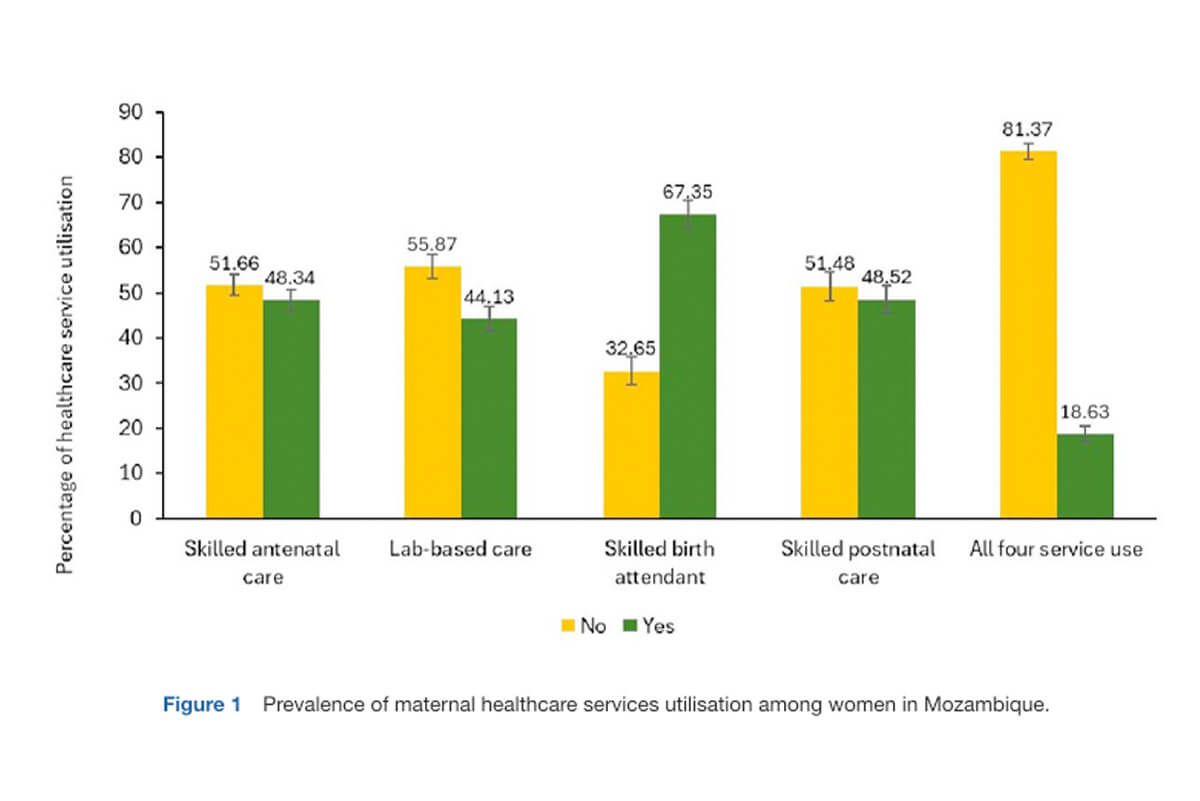
Results: Overall, 18.6% of women received all four maternal healthcare services. Maternal healthcare utilisation showed significant inequalities favouring wealthier and more empowered women. Regression model suggests that women who were classified in the highest quintile for empowerment index (adjusted OR (aOR)=2.17, 95% CI=1.41 to 3.33), women in the two highest quintiles for wealth index (richer: aOR=2.37, 95% CI=1.41 to 3.98; richest: aOR=2.60, 95% CI=1.41 to 4.79) and women residing in an urban area (aOR=1.35, 95% CI=0.99 to 1.83) were significantly associated with the utilisation of all four healthcare services. Other factors like exposure to media (television/radio/newspaper), husband’s educational status, distance to the nearest health facility and province/region of residence also determined maternal healthcare services utilisation.
Conclusion: Our findings highlight the need for targeted interventions such as improving women’s education, healthcare infrastructure and distance barriers and promoting gender equality to ensure greater service utilisation. These findings could help advance further development and implementation of Mozambique’s national strategies, and development assistance, for community-based primary healthcare and women-centred care as they provide the latest evidence on this topic.
+++
Stories of safe abortion care in Mozambique: Women share their diverse experiences with safe abortion care in the nation with one of the most liberal abortion laws in Africa
https://www.doctorswithoutborders.org/latest/stories-safe-abortion-care-mozambique 23 January 2024
+
How MSF is expanding access to safe abortion care in Mozambique
https://www.doctorswithoutborders.org/latest/how-msf-expanding-access-safe-abortion-care-mozambique, 22 January 2024
by Doctors Without Borders/Medecins Sans Frontieres

At MSF Mozambique 2023 © Miora Rajaonary

A patient speaks with a midwife. © Miora Rajaonary
… Unsafe abortion [is] one of the leading causes of maternal mortality globally. To reduce the high number of women dying from unsafe abortions, Mozambique in 2014 legalized abortion up to 12 weeks and beyond in cases of rape, incest, and severe fetal anomalies such as heart defects. This essential care is provided free of charge. But even though abortion is free and legal, other barriers including stigma and misinformation can still make it difficult to access safe care.
In the city of Beira, Doctors Without Borders/Médecins Sans Frontières (MSF) provides safe abortion care to women, girls, and other pregnant people from communities that are often excluded from health services or who might avoid seeking care for fear of stigma or discrimination, including sex workers and adolescents. To increase access to safe abortion care across the city, MSF’s team also trains staff working at clinics run by the Mozambican Ministry of Health.
Most abortions in Beira are medication abortions. Patients are given a combination of mifepristone and misoprostol pills to take at home. Decades of scientific research have shown that these two drugs will safely and effectively end a pregnancy over 95 percent of the time, with a less than 1 percent chance of severe complications. Staff walk patients through the process beforehand so they know what to expect, and they only need to come back to the clinic if they have questions or problems.
At community clinics run by MSF and those run by the Ministry of Health in Beira, we spoke with women who have had an abortion and the health staff who’ve supported them. We asked them if they wanted to share their stories. Here’s what they told us, in their own words. [All patient names have been changed…]
“I don’t want to have a child without dignity”: Michelle, 34, sex worker and mother
I got pregnant because a condom broke. My youngest child was just one year old. I went to the health center and was seen by MSF. The HIV test was negative. Then I took the pregnancy test, and it was positive. I started crying. Paula [an MSF nurse] asked me, “What do you want to do?” I said I didn’t want to keep this pregnancy—it was an accident. I wouldn’t be able to, it would be too expensive. I don’t know the father. The best thing for me was to end this pregnancy. They gave me a pill to take at the clinic. And they gave me more pills to put under my tongue at home after my meal. And that’s what I did. Before I left, I asked for a contraceptive implant so I wouldn’t get pregnant again. Many people have unsafe abortions. The traditional healer gives us some medicine to take, and we could die. I don’t know how to get the [right] medicine to take on my own, but when I come to the health center, they do know, and they can give it to me. At the health center, when we speak out, we get help. With the traditional healer, we don’t get any support. At the health center, we are not abused, we do not pay for anything. It is not allowed to just let people die.
“I decided I couldn’t manage a child and school”: Beatriz, 28, midwife trainee
[Last year,] I decided I couldn’t manage a child and school at the same time, so I came here to the health clinic. They told me about the steps to have a safe abortion. I had support from my family [and] from my husband. At first, he didn’t agree, but after we discussed my situation—that I was studying—he accepted it. In my experience, it is a myth that you can’t get pregnant again after having a [safe] abortion. Because I got pregnant again normally. Nothing changed and nothing will change. I’m seven months pregnant now.
“I did it wrong. I did it at home without any support”: Gloria, 23
I was 20 years old when I had my first abortion. I did it wrong. I did it at home without any support.
I was afraid to face the nurse. And there’s always a rumor in the neighborhood that you can’t go to a health center because they’ll ask for a guardian; they’ll ask for witnesses; they will ask for things that you can’t give them. People told me that the nurses would charge me. That is a myth. There are lots of myths about the health center and that’s what made me afraid to go. It went badly. It was scary, and I went through it on my own. Then, I was afraid of losing my life—so I went to a health center, and they helped me. The second time [I had an abortion], I went to a health center, and I felt better. They told me if there was any problem, I could come back. They said, “We will help you.” It was very good and safe. None of the things happened that they said [would happen] in the neighborhood. For any friend who is in this situation, I would refer them to the health center, and I would tell them how I was treated.
I asked her to keep it a secret: Olivia, 32, medical student
To begin with, [I was afraid of] my family being disappointed in me. I was a little afraid that they wouldn’t be willing to pay my school tuition. So that was a lot of it. I ended up telling my older sister. She did not approve at the time. Then she ended up accepting it. The only thing was that I asked her not to tell anyone at home, [especially] my parents. I asked her to keep it a secret so as not to create disruption in the family.
Working with communities to break down barriers to safe abortion care
MSF’s approach is community-centered and peer-led, aimed at creating safe, trusting environments where all people feel comfortable accessing the health care they need. We provide direct care and health education through mobile and community clinics in locations where patients feel comfortable seeking care.
MSF teams train and mentor peer educators to provide reliable health information, guidance, and support to their communities on safe abortion care and other health issues including HIV and sexually transmitted diseases. MSF also supports 11 Ministry of Health facilities in Beira to decentralize safe abortion care across the city, bringing it closer to communities. Staff at these clinics now provide roughly 230 safe abortions per month. From January 2022 to June 2023, the provision of safe abortion care increased by 41 percent, and post-abortion care decreased by 73 percent. While post-abortion care includes spontaneous abortion (miscarriage) as well as unsafe abortion, we believe the decrease is likely due to fewer women resorting to unsafe methods to end their pregnancy now that safe abortion care is more easily accessible.
The decentralized approach has three pillars: donating supplies of abortion medications and contraceptives, training staff in the provision of safe abortion care, and a mentorship program to increase the quality of care. The main goal of the mentorship program is to equip health care workers with skills to appropriately serve people from marginalized groups, particularly sex workers, and aims to make health facilities places free of prejudice, where everyone feels safe asking for care.
Some health staff are hesitant to provide medication abortion beyond 12 weeks, despite it being legal in Mozambique up to 16 weeks in cases of sexual violence. MSF is trying to address issues like this through our mentorship program with Ministry of Health staff at the clinics we support throughout Beira. Various local advocacy groups are also calling for the 16-week limit to be extended to all people seeking safe abortion care, as limiting access to this service in the second trimester severely endangers the lives of women who were not able to access abortion services earlier in their pregnancy.
Isaura is a nurse who works for the Ministry of Health at the Fantasia Health Center in Beira. She was trained by MSF and has been providing safe abortion care for nearly three years. “I feel good [about providing this care],” said Isaura. “We used to get a lot of incomplete abortions, a lot of unsafe abortions—they used to take [unsafe] pills, they used to insert sticks. Since we started doing safe abortion, we don’t have many problems with unsafe abortions in the community anymore. We have prevented deaths.” The number of abortions the clinic provides fluctuates, but Isaura said it can be up to 60 in a month. Most people who come for abortion care are between 15 and 30 years old, but some are older as well. Isaura and her team also offer counseling to people to discuss any questions or concerns and to offer family planning.
Countering myths and misinformation about abortion
Misconceptions about abortion and contraceptive care are common in Beira. For example, many people believe that using a contraceptive could mean they will not be able to get pregnant in the future. This is also a common myth about the consequences of safe abortion.
MSF has also heard from women who reported being charged by health care providers for safe abortion care—a service that should be free. “I didn’t know what abortion was—it was my first time,” said Maria José. “When I got [to the clinic], they didn’t take care of me properly. They treated me aggressively and charged me money—I paid them 500 meticais [about $8—whereas most people live on less than $2.15 a day].” It’s important that people know they should not be charged for safe abortion care so they do not resort to unsafe methods because they think they can’t afford it.
MSF uses various tools to counter myths and spread accurate health information to the community about safe abortion care. We place advertisements and host discussions on social media and the radio, provide a hotline that people can call for additional information, and partner with local theater groups who perform skits about sexual and reproductive health care.
MSF also facilitates workshops, known as Exploring Values and Attitudes Towards Abortion (EVA) at our community center and at facilities run by the Ministry of Health. The workshop aims to challenge harmful beliefs and practices regarding abortion and build an understanding of the need for access to safe abortion care. Paula, a Ministry of Health nurse at Munhava Health Center, initially struggled with her own feelings about providing safe abortion care. She faced judgment from her colleagues for the service she was providing and felt disconnected from her work. After MSF conducted an EVA workshop at the Munhava health facility, Paula stopped being criticized by her colleagues. “After the EVA training, everyone understood the importance of abortion,” she said. “So, from then on, everything was peaceful.”
“Sometimes people are afraid to go to the medical center [thinking] they will be criticized because they went for an abortion,” she said. “We have to give the advice that no one should feel ashamed to get an abortion. In Mozambique, we have a law that defends that you can have an abortion. I don’t think we have to be ashamed to do that.” (Maria)