


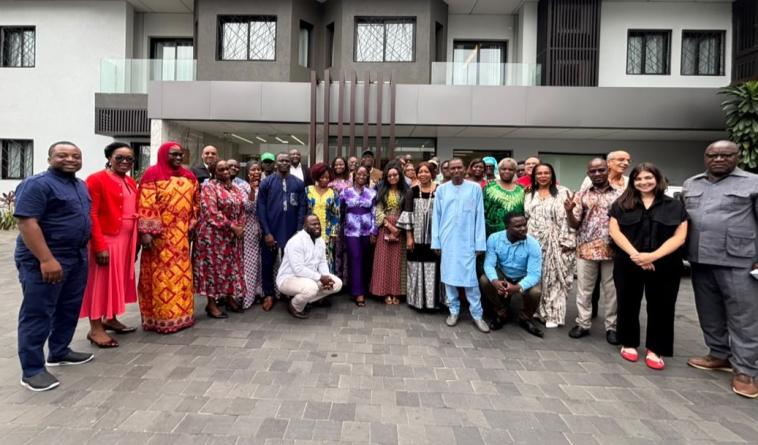
Last month, FIGO’s Community of Practice (CoP) gathered in Abidja, Côte d’Ivoire, to discuss progress and challenges in their efforts to expand access to safe abortion across more than 20 African countries.
FIGO
This learning and collaboration platform brought together colleagues from FIGO, the African Society of Gynaecologists and Obstetricians (SAGO), la Fédération des Associations de Sages-Femmes d’Afrique Francophone (FASFA) (Federation of Midwives Associations of French-speaking Africa, national OBGYN societies, the ODAS Centre and The International Planned Parenthood Federation (IPPF) to share experiences, knowledge and tools to strengthen health systems and safe abortion access in the region.
Professor Traoré, of the Malian Society of Gynecology and Obstetrics (SOMAGO) and Professor Diallo of the Société Guinéenne de Gynécologie-Obstétrique (SOGGO) told us about recent achievements and the urgent need for coordinated action.
A growing movement
When the CoP’s initiatives first began, few participants spoke openly about abortion. During the initial meetings, discussions were hesitant. Today, meetings attract more participants, both online and in person and the topic has become an established part of the conversation.
“Many people now have the courage to speak about safe abortion publicly. This shift in attitudes represents a major achievement: the discussion has expanded to include healthcare providers, national professional societies and, in some cases, religious leaders.” (Professor Traoré, OB-GYN and member of SOMAGO)
This change is not measured solely by the number of people speaking out. It also paves the way for greater understanding of rights, laws and standards governing abortion care. Benin, Mali and Togo are among the countries where legal revisions have addressed this issue. In another national context, a proposed amendment to the reproductive health law is currently under consideration.
However, Professor Diallo emphasises that the process is not yet complete: a proposal only becomes
tangible progress once it has been adopted and translated into practice.
Overcoming resistance, driving change
At its October 2026 meeting, the CoP held specific break-out sessions for various themes, including on research and innovation. In particular, self-managed abortion arose as an important next step to promote access and choice in abortion provision. For the CoP participants, the workshop offered an opportunity to engage in key topics in the abortion space and to reflect on the latest recommendations of the World Health Organization. However, introducing a new concept is not enough to secure its acceptance. Some healthcare professionals remain sceptical about self-care, particularly because of concerns about potential complications. Explaining the approach, encouraging dialogue and supporting change are therefore essential.
Resistance is also rooted in the sensitive nature of abortion, conscientious objection, and social and cultural norms. These barriers can prevent commitments made at national level from being implemented. Advocacy alone does not guarantee access to services: even when the law permits certain procedures, healthcare providers may refuse to perform them. The gap between legal rights and people’s lived experiences therefore remains a central concern.
To help bridge this gap, Professor Traoré calls for continued awareness-raising, advocacy and research, alongside stronger collaboration among stakeholders. National professional societies have a crucial role to play. They must work closely with midwives’ associations, civil society organisations and the relevant ministries, particularly those responsible for health and family affairs.
A change in the law alone is not enough. We need established platforms that bring together government representatives, professional societies, civil society organisations and technical partners. Unfortunately, stakeholders often work in isolation. Shared spaces would help align perspectives, identify challenges and develop coordinated responses.
– Professor Diallo, OBGYN and member of SOGGO
Looking ahead to the next five years, participants hope to see solutions emerge to address new challenges, particularly access to care and the use of artificial intelligence. Yet their most pressing aspiration is more immediate: ensuring that women and girls can access quality sexual and reproductive health services.
SOURCE: FIGO: https://www.figo.org/news/working-together-to-remove-barriers-to-safe-abortion-care. PHOTO: FIGO Community of Practice (CoP) gathered in Abidja, Côte d’Ivoire.