



Advanced practice clinicians (APCs) are a critical part of the reproductive health care workforce in the USA. First-ever national estimates by Guttmacher highlight just how central they are to abortion care across the United States and how state laws both facilitate, and in many cases limit, patients’ access to that care.
We’re also sharing the National Abortion Federation’s (NAF) updated APC Abortion Provider Toolkit, a valuable resource for providers and advocates alike.
Advanced practice clinicians, including nurse practitioners, physician associates and certified nurse-midwives, have long played a key role in abortion care. They provide abortions directly and support patients through services such as counselling and follow-up care.
Our new fact sheet finds that APCs provided more than 360,000 abortions in the United States in 2025, accounting for nearly one-third of all clinician-provided abortions nationwide. In the 26 states and jurisdictions where APC provision is permitted, they provided 43% of clinician-provided abortions.
Advanced practice clinicians—which include physician associates (also known as physician assistants), advanced practice registered nurses, nurse practitioners, certified midwives and certified nurse midwives—play critical roles in many health care settings across the United States. In abortion care settings, advanced practice clinicians (APCs) have long provided abortions directly as well as wraparound care such as pre- and post-abortion counselling. Decades of research have shown that advanced practice clinicians can provide both medication (abortion pills) and procedural abortions safely and effectively; and the risk of complications from any such abortion (regardless of method) is very low, and multiple randomized controlled trials have found no differences in complication rates between APCs and physicians. Despite this, many states still restrict APCs’ ability to provide abortion care. Perhaps it is time for that too to change!
- Abortions provided by APCs represent almost a third of clinician-provided abortions nationwide.
- In the 26 states and jurisdictions where APC provision was permitted under state law in 2025, 43% (90% UI 41–45%) of all clinician-provided abortions were provided by APCs.
- These estimates understate the role of APCs as it only counts abortions directly provided by APCs and does not include APCs’ involvement in other critical aspects of care (such as counselling or follow-up care), including in states where they cannot directly provide.
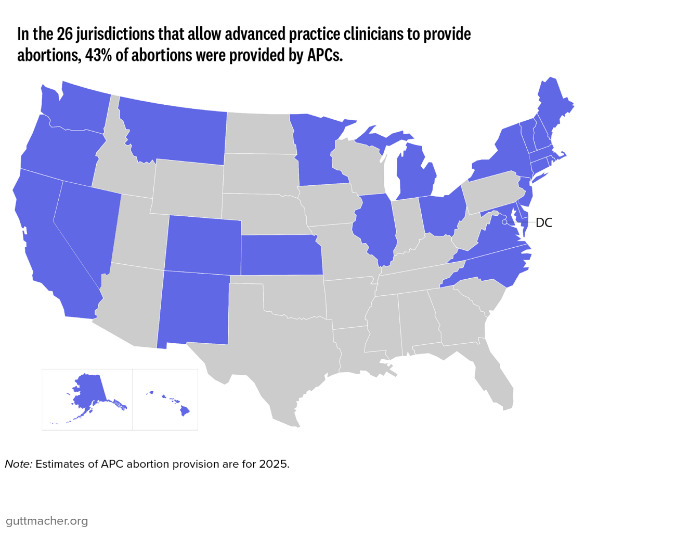
In the 26 jurisdictions that allow APCs to provide abortions, 43% of abortions were provided by APCs. (SOURCE: Estimates of APC abortion provision are for 2025.) In the map below, the states coloured blue permitted APC abortion provision in 2025.
Legal and regulatory frameworks impacting APC provision
Authorization for advanced practice clinicians to provide abortion care is determined by a complex web of state laws, policies and other considerations. Many states have laws directly addressing APC care provision, and 25 states and Washington, DC permit APCs to provide abortion care. Among those, some states place limits on the types of abortion care that may be provided by APCs. For example, some states limit APCs to providing only medication abortion, limit the upper gestational duration at which they can provide care, or require certain types of specialized training. Some states also specify which types of APCs (e.g. physician associates or nurse practitioners) can provide abortion care.
Twenty-five states bar APCs from providing abortion care, limiting the practice only to physicians through state law. (Thirteen of those 25 states also have total bans on abortion provision.) Given the extensive literature on the safety and efficacy of APC provision of abortion care, these restrictions are not based on evidence; they restrict access to abortion care rather than enhance patient safety.
The care that APCs can provide is also determined by the professional societies and regulatory boards that establish their scope of practice, and by restrictions placed on that scope by state laws regarding medical practice in general. Such laws regulate the types of care that clinicians, including APCs, can offer, such as administering or prescribing certain medications, performing certain procedures and more. These laws can also determine whether APCs can practice independently, or if they are required to provide care under the supervision of a physician—policies that can impact APC abortion care, depending on the state. For example, some states do not permit APCs to provide outpatient surgical care, which could limit their ability to provide procedural abortion care. Other states do not permit APCs to prescribe medication without physician supervision, meaning that APCs in those states can only provide medication abortion in certain practice environments.
Lastly, APCs’ ability to provide abortion care may be limited by the logistics of their particular practice environment. For example, an APC who lives in a state where they are not allowed to administer the sedatives sometimes used during procedural abortion may not be able to provide care at some clinics—not because they are legally prohibited from doing so, but because it does not make sense for clinic staffing. Similarly, in states where APCs cannot practice independently, some hospitals and clinics providing abortion care may opt not to employ them for reasons of clinical efficiency.
SOURCE: Guttmacher Institute. October 2026.