


by Stephanie Munduruca, Evelyn Fuentes-Rivera, Joaquin Arnoldo Escobar Trinidad, Raffaela Schiavon, Blair G Darney
Contraception: https://www.contraceptionjournal.org/article/S0010-7824(26)00363-X/fulltext
Volume 163, September 13, 2026, Open access
Abstract
Objective
Long-acting reversible contraceptive (LARC) methods are often grouped in contraception studies, although they differ in ways that may influence patient preferences and access. This study examines trends in intrauterine device (IUD) and implant use in Mexico, and identifies factors associated with implant use compared with IUD use.
Study design
We used the 2009, 2014, 2018, and 2023 waves of the Mexican National Survey of Demographic Dynamics (ENADID). The sample included women aged 15–45 currently using LARC. We described the characteristics of LARC users in 2023 and estimated percentage point changes in prevalence for implant and IUD use as a proportion of all modern method use across survey periods. Multivariable logistic regression identified factors associated with implant use versus IUD (reference) among LARC users in 2023.
Conclusion
Use of LARC methods in Mexico has shifted towards increased implant use and decreased IUD use, suggesting a shift between methods rather than expansion of overall LARC use.
Implications
Increasing implant use alongside declining IUD use may reflect improved access but could also indicate constrained contraceptive choice. Ensuring availability of both methods is essential to support informed, patient-centred, and contraceptive decision-making.
*****
1 Introduction
Long-acting reversible contraception (LARC), intrauterine devices (IUDs) and subdermal implants, are highly effective for contraceptive methods with efficacy rates exceeding 99%. These methods are safe across a wide range of users, including adolescents and nulliparous women. Although IUDs and implants are often grouped together as LARC, they differ in important ways that can influence patient preferences or accessibility. IUDs require pelvic insertion and more specialized training while implants involve a quick insertion in the arm that may be more widely available in primary care settings. Given that patient preferences and health system factors differentially influence the utilization of IUDs and implants, it is useful to examine them separately rather than as a single LARC category.
In Mexico, where over 33 million women are of reproductive age, the contraceptive prevalence rate is 63%, with LARC methods accounting for 17% of all modern contraceptive method use. The country faces significant reproductive health challenges such as unintended pregnancies, particularly among adolescents, that underscore the importance of expanding LARC access. Expanding access to LARC, particularly outside the postpartum setting has the potential to improve contraceptive access and reduce unintended pregnancy in Mexico, especially among adolescents. Previous research has described geographic, age, and parity patterns in implant use, in which implant use appears concentrated in the southern region of the country, among younger woman, and among parous women.
Despite previous research looking into implant uptake over time and factors associated with implant use versus other contraceptive methods, it remains unclear whether the increase in implant use observed in Mexico represents uptake among new contraceptive users or a shift from IUDs to implants. The purpose of this study is to describe trends in IUDs and implant use as a proportion of overall modern method use (including sterilization, oral contraceptives, injectables, implants, IUDs, condoms, and other modern methods), describe population-level shifts between LARC methods, and identify factors associated with implant use compared to IUD use.
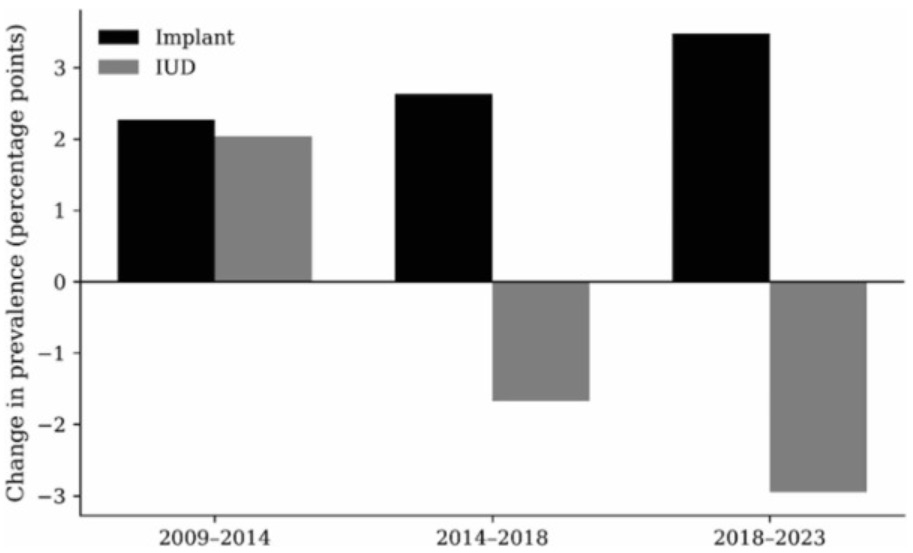
Figure 2. Changes in the in prevalence of implant and IUD use between survey waves among women who have ever used a modern method Mexico
We found that among LARC users in 2023 (Table 2) compared with adolescents aged 15–19 years, women aged 20–29, 30–39, and 40–49 years all had significantly lower odds of implant use compared with IUD use (OR 0.41, 95% CI 0.31–0.53; p < 0.05). Women with one or two children were less likely to use the implant than nulliparous women (OR 0.78, 95% CI 0.64–0.97; p < 0.05). Having public health insurance (Seguro popular, INSABI and IMSS Bienestar) was associated with 35% higher odds of implant use (OR 1.35, 95% CI 1.15–1.58; p < 0.05) compared with women who do not have any health insurance. Among LARC users, women in the highest socioeconomic quintile compared to women with lower socioeconomic quintile (OR 0.69, 95% CI 0.55–0.86; p < 0.05), those living in urban areas compared to those living in rural areas (OR 0.58, 95% CI 0.49–0.69; p < 0.05), and those in households where the head does not speak an indigenous language compared to those who do speak an indigenous language (OR 0.71, 95% CI 0.54–0.92; p < 0.05) had lower odds of using an implant relative to an IUD. Similarly, women living in northern states were less likely to use an implant rather than an IUD compared with those in southern states (OR 0.50, 95% CI 0.43–0.58; p < 0.05).
4 Discussion
This study describes changes in the prevalence of IUD and implant use over time in Mexico and identifies factors associated with current implant versus IUD use. We found a continued increase in implant use and a concurrent decline in IUD use between 2009 and 2023, with the most substantial shifts in LARC method use occurring between 2018 and 2023. Together, these findings point to a shift in Mexico’s use of LARC methods, suggesting a method mix shift of implants for IUDs rather than an overall expansion of LARC use.
Between 2018 and 2023, implant use increased by 3.48 percentage points, while IUD use dropped by nearly 3 percentage points over the same period. The opposing trends between these methods during this same period indicate that rising implant use is occurring in the context of decreasing IUD prevalence rather than simply reflecting expansion of overall contraceptive coverage. This pattern highlights the importance of examining LARC methods separately when assessing changes in contraceptive use. While this method mix shift may reflect improved access to implants in certain settings, it also raises questions about whether the full range of LARC methods is offered consistently. Given that implants require less specialized training than IUDs, their increasing prevalence may reflect shifts in provider clinical competence or supply chain constraints rather than user preference. Other structural factors, including differences in provider training, and access to facilities capable of providing IUD insertion and removal, may also influence which methods are consistently available to users. These factors can influence whether individuals are offered the full range of contraceptive options and effect informed autonomous decision making. Understanding whether this method mix shift reflects choice or limitations will be critical in evaluating contraceptive access in Mexico.
Our analysis among current LARC uses further illustrates how implant and IUD use differ across population groups. Consistent with prior research from Mexico and worldwide, younger women were more likely to use implants, with the likelihood of implant use declining with age. Parity was also associated with method type, although this relationship appears to have evolved over time. Earlier studies in Mexico have documented use of implants higher among those with at least one live birth. In contrast, our most recent analysis suggests changes in this pattern for implants, with women with one or two children having lower odds of using an implant versus an IUD compared with nulliparous women. Given its strong and changing association with contraceptive method choice, parity remains a critical independent variable to include in analyses of LARC use. Public health insurance was associated with higher odds of implant use compared with women who do not have any health insurance. This raises questions for future work about whether patterns of implant use in Mexico are driven by patient preference or by health system structural factors. These findings are consistent with prior research documenting regional and socioeconomic variation in LARC method use in Mexico and more broadly across Latin America and the Caribbean, where substantial inequalities in LARC use have been observed across countries and population groups. Together, this evidence suggests that differences in health system organization and access to contraceptive services may contribute to observed patterns of LARC use alongside individual preferences.
Overall, this study extends prior analyses of LARC use in Mexico, drawing on the most recent ENADID, and highlights that recent increases in implant use coincide with declines in IUD prevalence. By quantifying these changes and identifying the populations most likely to use implants versus IUDs, our findings help clarify how Mexico’s contraceptive use is evolving. Rather than treating LARC methods as a singular category, this analysis allows us to see how different LARC methods are distributed and used unevenly across demographic and geographic groups in Mexico.
This study is limited by its cross-sectional design, which prevents causal interpretation of the associations observed. Additionally, the use of demographic survey data limits our ability to track individual users over time. As such, we describe a method mix shift at the population level, not method switching by individual users. We also lack information on users’ motivations, counselling experiences, and reasons for discontinuation or method shift, which would provide valuable context to understand method choice and access. Future research should explore these areas and evaluate reasons for continuation and discontinuation between LARC methods.
Between 2018 and 2023, Mexico experienced a marked increase in implant use alongside a decline in IUD use. While a shift from IUDs to implants may reflect improved access in some settings, it may also indicate constrained choice driven by provider capacity or supply limitations rather than informed user´s preferences. These trends may reflect both targeted policy efforts, including implementation of Mexico’s National Strategy for the Prevention of Adolescent Pregnancy (ENAPEA) and expansion of adolescent friendly reproductive health services, as well as structural differences in provider training, service capacity, and access to LARC services across regions. Future research should examine user preferences, and how LARC counselling may affect informed contraceptive choice across Mexico.