


by Tarun Shankar Choudhary, Sarmila Mazumder, Oystein A Haaland, Sunita Taneja, Halvor Sommerfelt, Ole F Norheim, Nita Bhandari, Kjell Arne Johansson
BMJ Global Health, Volume 11/Issue 9, 2 September 2026. Open access.
PDF: https://gh.bmj.com/content/bmjgh/11/9/e021719.full.pdf
Abstract
Introduction Kangaroo mother care (KMC) is a proven, low-cost intervention to reduce neonatal mortality, yet its coverage remains limited in most low- and middle-income countries (LMICs), including India. In this study, we examined the impact of scaling up KMC in India on distribution of health and financial outcomes using an extended cost-effectiveness analysis (ECEA) framework.
Methods Building on primary data from a randomised controlled trial (RCT), we modelled the health and financial outcomes of scaling up KMC to 95% coverage nationally. We estimated lives saved, disability-adjusted life-years (DALYs) averted, out-of-pocket expenditure (OOPE) averted and cases of catastrophic healthcare expenditure prevented. Estimates were disaggregated by socioeconomic quintiles and geography. We used deterministic and probabilistic sensitivity analyses to assess the robustness of our findings.
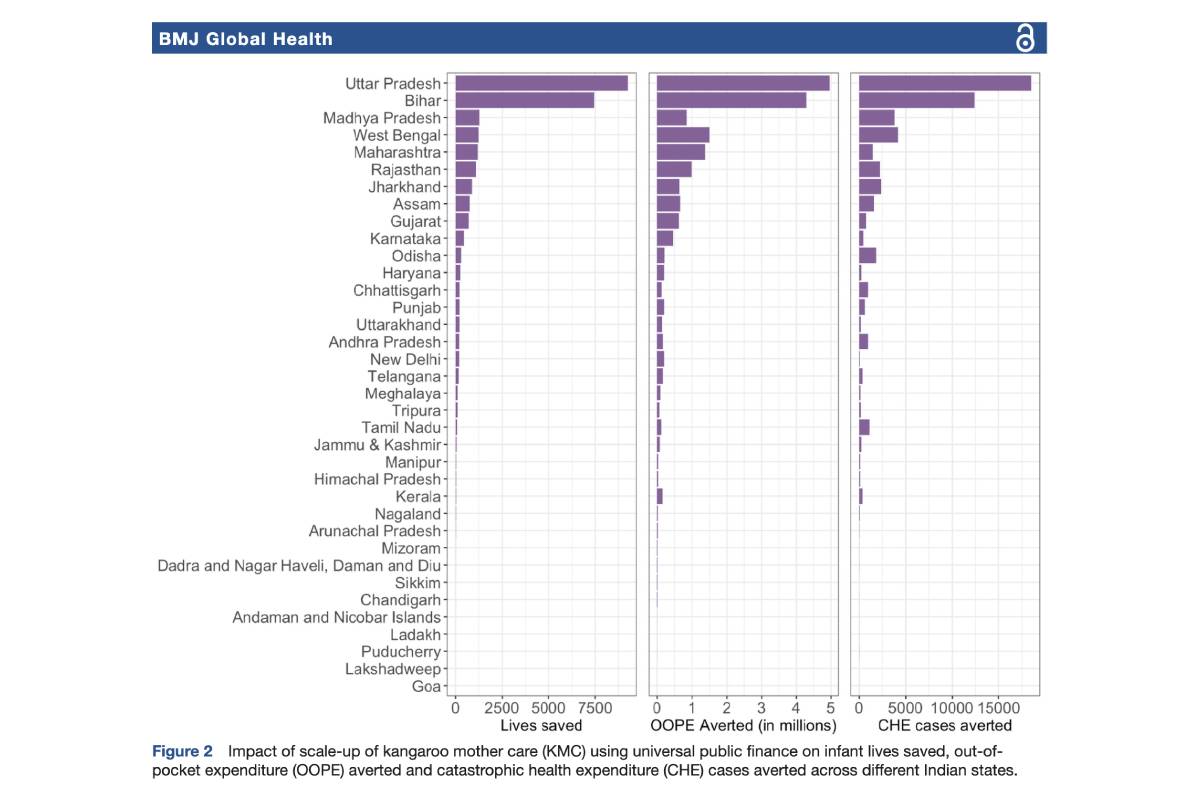
Results Scaling up KMC in India could save around 26,000 neonatal lives annually, avert approximately 1.6 million DALYs, reduce OOPE by around US$13 million and prevent an estimated 57 000 households from experiencing catastrophic health expenditures. Three-fourths of the benefits would be concentrated in the lowest two socioeconomic quintiles. Six high-burden states, including Uttar Pradesh, Bihar and Madhya Pradesh, accounted for 90% of the health and financial gains. The incremental cost-effectiveness ratio ranged from 0.08 to 0.17 times gross domestic product per capita for India across different quintiles. Probabilistic sensitivity analysis showed scaling up KMC would be cost-effective in 97.8% of simulations.
Conclusion Our findings suggest that scaling up KMC is cost-effective and can reduce health inequities, particularly benefiting the lowest socioeconomic groups and high-burden states. Incorporating geographical disaggregation and using primary RCT data into ECEA enhance its utility for informing evidence-based, equity-focused health policies in LMICs.
What is already known on this topic
- Kangaroo mother care (KMC) is proven to reduce neonatal mortality among preterm and low-birthweight infants, but extended cost-effectiveness analyses (ECEAs) of KMC are lacking in India and other low-income countries.
- Previous ECEAs in maternal and child health mostly relied on secondary data, focused narrowly on socioeconomic equity and seldom examined geographical disparities that are critical in settings with a decentralised health system.
What this study adds
- Using primary data from a randomised controlled trial (RCT), we provide robust estimates of KMC’s health, equity and financial protection impacts in India.
- By introducing geographical disaggregation alongside socioeconomic analysis, we show that three-fourths of the benefits accrue to the poorest households, and six high-burden states account for 90% of the health and financial gains.
How this study might affect research, practice or policy
- Our findings demonstrate that scaling up KMC through universal public finance is a cost-effective and equity-enhancing intervention in India.
- They highlight the value of ECEA in extending the policy relevance of RCTs and strengthen the case for prioritising equity-focused maternal and child health strategies in low- and middle-income countries.
Figure 2 shows that six states—Uttar Pradesh, Bihar, Madhya Pradesh, West Bengal, Maharashtra and Rajasthan—would account for over 90% of the benefits across all outcomes (lives saved, OOPE averted and CHE cases prevented).