


by Fred Nunes
Fred Nunes, now retired, lectured at the University of the West Indies and worked with the United Nations Development Programme, the Pan American Health Organization, and the World Bank. He is committed to women’s reproductive health.
The High Court’s Decision
On Thursday July 23, 2026, responding to a constitutional challenge on Dominica’s abortion law, the High Court managed to deliver a decision that left both anti-choice evangelicals overjoyed, and pro-choice advocates so delighted they claimed the decision as a landmark victory.
At the time of writing, the text of the judge’s ruling was not yet available, so every caution Is required. It seems that the judge assessed the law as unreasonably restrictive and ordered the government to add to the sole exception, saving the life of the mother, by expanding lawful exceptions to include rape, incest, severe foetal anomaly, and to protect the health of the woman. These recommendations track almost perfectly with CEDAW Committee’s Concluding Observations for Antigua and Barbuda, 2019. (Although Dominica ratified CEDAW in 1980, it has never provided a report.) The judge gave the government six months to put her instructions in place.
The evangelicals were delighted because the law was not declared unconstitutional, and the limited exceptions quenched their fears of “abortion on demand”. And as one prochoice ASPIRE advocate said, “We won, we lost, and I am delighted,” because the court (a) did not declare the law constitutional, instead (b) it acknowledged its undue restrictiveness, yet (c) the ruling is so narrow that it will probably cover fewer than 5% of abortions, and so could provide a convenient basis for an appeal.
Background: How did we get here?
At a dinner of less than a handful of advocates in August 2021, Professor Rebecca Cook asked others a simple question: “Given your assessment of the reluctance of Caribbean parliaments to address the issue of abortion, why not try the courts as happened in Northern Ireland recently?” That question triggered the journey.
They set out on a two-pronged approach. One arm was a strictly legal challenge to the constitutionality of the abortion law; the other was an assessment of the state of abortion in Dominica.
They had to select a country or a court and soon set their eyes on the Caribbean Court of Justice (CCJ) as the most suitable target, since they regarded it as the most liberal one in the region. But getting there meant finding a country with the restrictive law from the 1860s.
Although the idea of the CCJ was conceived in 1970 as a further step in decolonization, it was not established until 2001 and did not become operational until 2005. And although ten countries happily signed the agreement in 2001, twenty years later, only four had acceded to it – Barbados, Guyana, Belize, and Dominica. Of these four, only Dominica still had the original colonial law. So, Dominica was chosen.
The tiny team had to find attorneys willing to work pro bono and they had to find partners or nurture a core of advocates in Dominica. They needed boots on the ground. They started in the gentlest fashion by asking the Attorney General to clarify the abortion law.
He eventually explained that a request for him to clarify sections 56 and 57 of the Offences Against the Person Act (OAPA), would require him “to opine on a hypothetical question” which was “improper for his office.” His awkwad refusal cleared the way for an approach to the High Court and the pro bono legal team of Rishi Dass, Anika Gray, Sasha Sukram, and Dawn Yearwood, set about that task.
The team filed its challenge with the High Court on April 26, 2024. Of course, as soon as the challenge was filed, the Catholic Church and evangelical groups were loud in their opposition and indicated their intent to register their opposition. To ensure that the Court received the benefit of a pro-choice Christian theological perspective, the advocates urged Caribbean Religious Voices for Justice (CRVJ) to prepare an affidavit. They prepared a persuasive submission based largely on the Wesleyan Quadrilateral.
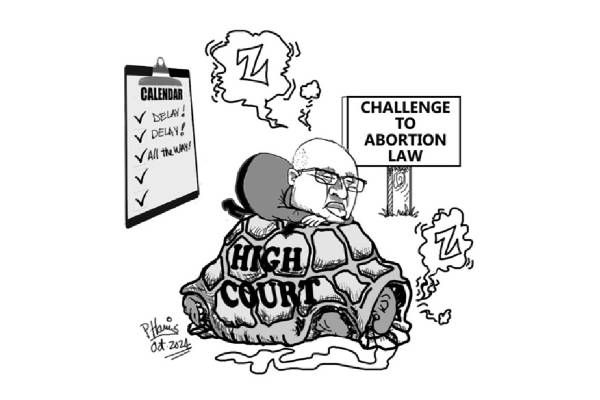
After an interminable game of delays and the inevitable gauntlet of the legal process, the claim was finally heard on October 21, 2025.
The Legal Challenge: making the case
Their legal challenge was rooted in five of the 17 rights guaranteed in the Constitution of Dominica. They demonstrated how Sections 56 and 57 of the Offences Against the Person Act that criminalised abortion violated each of those five constitutional rights. The table shows the arguments they employed:
| Section | Each Constitutional right / and how it is violated by Sections 56 & 57 of the OAPA |
| 1c | The right to protection of privacy of the home |
| Criminalised abortion prevents choice; prevents women form exercising autonomy over when or whether to become a mother; denies the dignity of bodily autonomy; constitutes undue government intrusion into individual space. | |
| 13 | The right not to be discriminated on grounds of one’s sex |
| Criminalised abortion only restricts women and there is no similar restriction on men; reinforces gender-based biases of women and motherhood; enables several sources of discrimination (stigma, gender, youth, poverty) to flow together and compound the harm of discrimination; denies access to abortion even for rape and incest; normalizes gender-based violence, and forces women to pay exorbitant prices for unregulated, clandestine services. | |
| 5 | The right to freedom from inhuman treatment |
| Criminalised abortion forces women to carry unwanted pregnancies, whether from rape, incest, non-viability, because they are life-threatening, or for any other reason. This constitutes mental anguish and is degrading and inhuman; reinforces the stigma of abortion; forces women and girls to seek services in unregulated, clandestine places; and excludes them from access to pre- and post-abortion counseling. These conditions dispose to later rather than earlier terminations, increasing the risk to women and girls. | |
| 1 (b) and 9 | The right to freedom of conscience |
| Criminalised abortion forces individuals to comply with beliefs that do not align with their conscience; forces motherhood on girls and women with no regard for their personal beliefs or reproductive autonomy. | |
| 1 (a) and 16 | The right to the protection of the law |
| Criminalised abortion prevents the use of the law to ensure the enjoyment of all the rights described earlier; imposes criminal sanctions where the law is uncertain and so fosters arbitrariness; serves to justify the government’s failure to develop policies and services for abortion care; and provide guidelines for clients and healthcare professionals for abortion services free of the fear of prosecution. |
The legal team also argued that the Constitution did not protect the rights of the foetus and so the Court had no obligation to balance the rights of the foetus against those of a woman. They pleaded with the Court to follow rulings of a High Court in Transvaal, South Africa and the Supreme Court in Canada in observing that the Constitution neither explicitly nor by implication extended rights to the foetus.
Beyond the Constitution, the legal team pointed to the state’s failure to honour its obligations under several international conventions it had ratified – the Convention on the Elimination of All Forms of Discrimination Against Women (CEDAW, 1980), International Convention on Economic, Social and Cultural Rights (ICESCR, 1993), Convention Against Torture (CAT, 2024), and Convention on the Rights of the Child (CRC, 1991).
The Social Challenge – ASPIRE’s research
Advocates for Safe Parenthood: Improving Reproductive Equity (ASPIRE) sought to place the rigorous legal case firmly in the context of the social reality of abortion in Dominica. They conducted three surveys, two of which were submitted to the Court.
One was a study of medical opinion on abortion and abortion law in Dominica. This revealed the profile of views across the health community. The results showed that senior health managers, doctors, nurses, pharmacists, and social workers were aware of the ineffectiveness and harm of the existing restrictive law (63%); they knew that abortion was widespread (91%); they favoured expanded access to lawful abortion – for rape, incest, foetal anomaly, and to protect the physical and mental health of the woman (79%). They believed the law should reduce the risk of harm to women and girls with unwanted pregnancies (89%); and that their professional associations had a responsibility to ensure fairness under the law (87%). And they wanted comprehensive sexuality education in schools (89%). Bottom line: the opinions of the healthcare community supported considerable liberalisation.
The other study examined the contraceptive knowledge, practice and reproductive experience of women attending public health clinics in Dominica. The results showed that 31% of adolescents were sexually active by age 15, but almost none of them attended clinics; 80% of so-called teenage pregnancies involved men 20 years or older; almost 1:5 last pregnancies (18.3%) ended in induced abortion; among women who reported an abortion, 81% reported having their first abortion by age 19; the three leading causes for abortion were timing (39%), socio-economic considerations, (24%), and age (20%). Sexual violence was commonplace: 19.6% reported experiencing forced sex, 18.6 % reported being sexually abused as a child, and 15% reported being abused by their partner. Only 27.9% reported that their last pregnancy was planned. Regarding contraceptive behaviour, knowledge was not the problem: everyone knew at least one method and 32% knew seven or more methods.

But in clear contrast to knowledge, during the survey period, 20% were not using any method. The leading reason for non-use was cost (34%), all other reasons were in single digits. Bottom line: the state of reproductive health in Dominica was a catastrophe.
Their third study was a survey of the opinions of religious leaders on abortion and abortion law. Contrary to the notion of uniform opposition to abortion from religious leaders, on almost every question, their responses occupied every position on a five-point Likert scale, from strongly agree to strongly disagree. There was wide diversity. The survey and the results followed the pattern of the medical opinion: the religious elite leaned liberal. The challenge for advocates was not the noise of the conservative minority; the far bigger challenge was the silence of the compassionate, liberal majority. Unfortunately, the outcomes were not as reliable as the other studies, since the survey never reached the desired sample size.
The Law and the Reality of Abortion
There can be no question that the High Court in Dominica has moved the law forward, and considerably so. Nor can there be any question that the Court’s limited move scarcely begins to address the enormity of the problem of abortion in the country. More than 83% of the reasons women gave for having abortions remain outside of the judges’ ruling.
Of course, much may turn on the interpretation of the provision to protect the health of the woman. If health is taken to include mental health and well-being as defined by the World Health Organization, then it could cover a very wide range of conditions. After all, any forced pregnancy, whether due to contraceptive failure or social and economic conditions, constitutes a source of mental stress. So, once again, the country is faced with a law that is uncertain.
Among the very strong response in the survey (89%), was the agreement on the need for Comprehensive Sexuality Education (CSE) in schools. That should be an immediate priority. Along with that, Dominica should follow the lead of seven other Caribbean countries that have reduced the age at which adolescents can have access to healthcare without parental consent. Dominica would do well to follow the age-graduated approach adopted in Argentina which resulted in a 57% decline in adolescent fertility in just six years.
The difficulty with decriminalisation is that it is counter-intuitive – especially for cultures in which punishment is the default solution to every social problem. The burden of evidence, however well-established, will be dismissed. What matters are stories, particularly stories from women who have had abortions. Faces matter. By age 49, 70% of women in Dominica will have had at least one abortion, so there can be no shortage of faces. The shortage is courage.
Pro-choice advocates must invest in major, sustained public education about the law and the need for decriminalisation. That needs to start now.
Finally, the groups most responsible for stigma are religious denominations. Advocates must strive to find liberal voices within that community and work to give them the courage to speak up and to speak out.
Above all, they must keep their eyes on the prize and continue their march to the Caribbean Court of Justice.
References
Letter from the Attorney General, Hon. Levi A. Peter, June 17, 2022.
High Court of Justice of the Commonwealth of Dominica, Claim No. DOMHCV2024/0082, 16 July 2025.
Medical Opinion on Abortion and Abortion Law in Dominica, Fred Nunes, Yvette Delph, Terrilia Ravaliere, Trudy Christian, Cordelle Lazare, Clayton Bryan, Sheridon Elliston, Tonia Frame, and Yusuf Yakubu, 2022-23.
A Survey of Women Visiting Public Health Clinics in Dominica, Fred Nunes, Yvette Delph, Terrilia Ravaliere, Trudy Christian, Cordelle Lazare, Clayton Bryan, Sheridon Elliston, Tonia Frame, and Yusuf Yakubu, 2022-23.
Spotlight Initiative, UNFPA, A Formative Assessment of Comprehensive Sexuality Education within the Health and Family Life Education Curriculum in the Caribbean.