


 Open Access

ISBN: 978-1-0672374-0-0
DOI: https://doi.org/10.29053/978-1-0672374-0-0
Pages: 287
Print version: Available
Electronic version: Free PDF available
About the publication
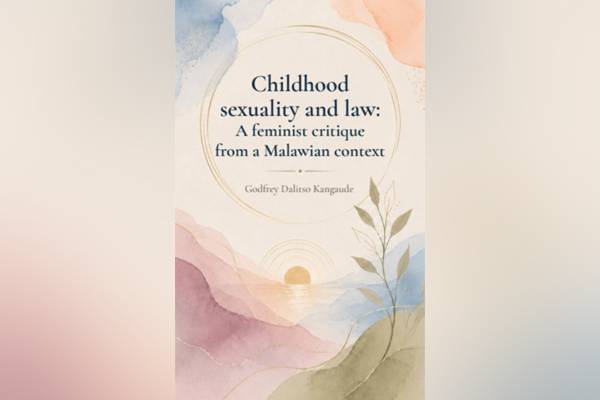
Childhood sexuality remains contested in law, policy, and public discourse. In this groundbreaking book, Godfrey Kangaude examines how legal systems construct children as sexual subjects and how these constructions shape children’s treatment.
Drawing on feminist poststructuralist theory and Malawi’s gender equality law, Kangaude argues that law produces meanings about childhood, gender, innocence, responsibility, and harm. Through critical readings of legal texts, the book reveals how institutional practices deny children’s sexual agency while claiming to protect their sexual health and rights.
“An important and courageous contribution to re-thinking child law and sexual agency.”
— Professor Ann Skelton
Table of Contents
Reviews
Foreword
Preface
Acknowledgments
Dedication
List of abbreviations
1 Introducing childhood sexuality and law
1 The child as a sexual subject
2 The context
3 The aim of the book
4 A note on definitions and key terms
5 Nature of inquiry
6 Scope
7 The book’s road map
2 A feminist framework to situate the critique
1 Introduction
2 Feminism and post-structuralist theory
2.1 A background to post-structural theory
2.2 Key concepts of post-structuralism
2.2 Key concepts of post-structuralism
2.3 African feminist and post-structuralist thinkers
3 A framework for analysing sex and gender equality law in relation to childhood sexuality
3.1 Bringing feminist post-structuralism to bear on childhood
3.2 Critiquing sex and gender equality law
3.3 Conceptualising the free and agentic subject in relation to ethical sexual agency
4 Concluding thoughts
3 Children’s sexual agency and gender equality law
1 Introduction
2 A case study: Deconstructing Malawi’s gender equality law
2.1 Background
2.2 A critique of the legal research methodology
3 Creating law and constructing gendered subjects
3.1 Conceptualising gender, sex and power
3.2 Men and women
3.3 Development
3.4 Education
3.5 Harmful practices
3.6 Envisaging transformative change
3.7 Sexual health and sexual rights
4 Where is the child in sex and gender equality law?
4.1 The gender equality law’s vision of children as subjects
4.2 The meaning of childhood
4.3 Children as agents and gendered subjects
4.4 Re-envisioning children as sexual and gendered subjects
5 Concluding thoughts
4 Childhood and the foundations for equitable sexual relationships
1 Introduction
2 Childhood, gender and sexuality
2.1 Childhoods: A socio-cultural, historical and political construction
2.2 The invention of adolescence
3 Age of consent to sexual intercourse and the colonial legacy
3.1 The development of age of consent laws in Europe
3.2 Childhood and regulation of sexual conduct in traditional Africa
3.3 Colonial and post-colonial Africa
4 The child as a sexual subject in the age of consent laws
4.1 English law up to 1885
4.2 Consent to sex and gender equality law
5 Gender-equitable sexual relationships
5.1 Gender, sex and sexuality
5.2 Balancing sexual autonomy and protection against coercion
5.3 Expanding the potential of the gender laws for children
6 Concluding thoughts
5 Sexualities and school cultures
1 Introduction
2 Sex and gender inequality in schools
2.1 What is the problem to address in schools?
2.2 The meaning of gender inequality in education
3 Understanding school sexuality cultures
3.1 Sex, gender and education
3.2 Schools as productive of student sexual identities
4 Gender law and sexual well-being in schools
4.1 The experience of discrimination structured by gender norms
4.2 Comprehensive sexuality education
4.3 Criminal law, discipline and the limits of punitive responses in schools
4.4 Toward involving children
5 Concluding thoughts
6 Children and adolescents as subjects of sexual health care
1 Introduction
2 Youth-Friendly Health Services (YFHS)
2.1 The meaning of ‘friendliness’ for the child as a sexual subject and adolescent
2.2 The challenges for children and adolescents amidst adult anxieties about sexualisation
3 The concept of sexual health and rights in the GEA
3.1 Equality and non-discrimination
3.2 Dignity
3.3 Access to sexual healthcare services
3.4 Protection and self-protection from sexually transmitted infections
4 Including children in sexual health programming
4.1 The politics of sexuality and health
4.2 Accepting childhood sexual behaviour as normative
4.3 Positive approaches to childhood and adolescent sexuality
5 Concluding thoughts
7 Concluding reflections for law, policy and practice
1 Introduction
2 A recapitulation
2.1 Conceptual foundations
2.2 Thematic areas: Childhood sexuality, criminal regulation and educational and health settings
3 Some suggestions to promote sexual well-being for children and adolescents
3.1 Promoting ethical sexual conduct from the formative years
3.2 The educational institution
3.3 Sexual health information, commodities and services
4 Conclusion
Epilogue
Bibliography
Open Access
This work is licensed under a Creative Commons Attribution 4.0 International License
SOURCE: Childhood sexuality and law: A feminist critique from a Malawian context