


May 18, 2026 Event, Features, News Adolescent, Amplify Change,
Chattogram, Chattogram Youth Event, Divisional SRHR Knowledge Fair 2026, Health Bangladesh, Hotel Agrabad, RedOrange, Sexual and Reproductive Health Rights (SRHR), SRHR, Teenage Pregnancy Campaign, Teenage Pregnancy Prevention Bangladesh, Youth, Youth Leadership Bangladesh, YPSA Bangladesh, Sajed Karim
I. Youth Share-Net Held a Divisional SRHR Knowledge Fair 2026 at Chattogram
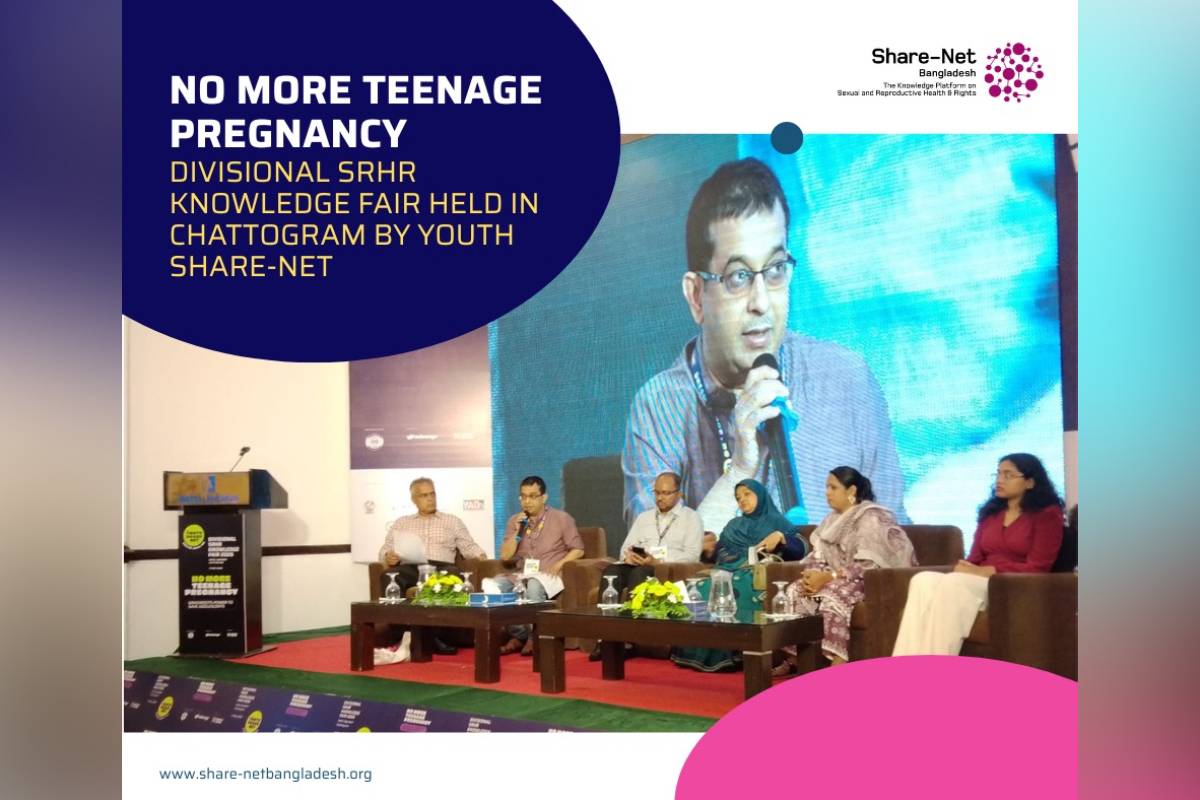
The Divisional SRHR Knowledge Fair 2026 was held on 17 May 2026 at Hotel Agrabad, Chattogram, under the theme “No More Teenage Pregnancy: Grassroots Power to Save Adolescents”. The daylong event was implemented by Young Power in Social Action (YPSA), organised by RedOrange, and supported by Amplify Change, bringing together around 300 young participants from across the Chattogram Division.
The programme commenced at 10 AM with the national anthem, followed by the inaugural session. The session was chaired by Arnob Chakrabarty, Managing Director of RedOrange. Welcome remarks were delivered by Dr. Mohammad Arifur Rahman, Founder and Chief Executive of YPSA, while Afra Nawar Rahman presented the briefing note.
The chief guest of the programme, Dr. Sheikh Fazle Rabbi, Divisional Director (Health), Chattogram, emphasised the urgency of addressing teenage pregnancy, noting that awareness must begin within families and be reinforced through collective social efforts. Begum Shahan Waz, Deputy Director of the Family Planning Department, attended as a special guest and highlighted ongoing government initiatives to tackle adolescent reproductive health challenges.
Chairperson of the session Arnob Chakrabarty noted that meaningful progress requires “aligning grassroots energy with institutional support to ensure adolescents are informed, empowered, and protected”. A powerful moment during the session came from Mosammat Mousumi, who shared her lived experience of child marriage and its long-term consequences, reinforcing the human dimension behind the statistics.
The second session, titled “Youth Realising Dreams: Aims vs. Action for SRHR,” was chaired by Jannatul Munia, Director-Strategy, RedOrange. The session explored the disconnect between youth aspirations and systemic barriers. Reflecting on the discussion, Jannatul Munia remarked that “young people already have the vision for change; what they need now is access, opportunity, and an enabling environment to act”.
The third session focused on the realities and risks associated with teenage pregnancy. Led by Shamima Chowdhury of BAPSA, the discussion brought together voices from law enforcement, legal aid, and the private sector. Panelists highlighted how stigma, lack of accurate information, and limited adolescent-friendly services continue to exacerbate vulnerabilities among young people.
The fourth session, “Networking for Action: Strengthening Systems and Community Response,” featured a keynote by Dr. Jahangir Alam, Civil Surgeon of Chattogram. The session was chaired by DR. Md. Nurul Haque, Director, Chattogram Maa-O-Shishu Hospital. Emphasising systemic coordination, Dr. Nurul Haque noted that “strengthening healthcare systems must go hand in hand with community awareness to ensure sustainable reductions in adolescent health risks.”
The final session, “Voice to Action: Shaping the Chattogram Declaration on Teenage Pregnancy,” was chaired by Nasim Banu Shyamoli. Prof. Dr. Pranay Kumar Mazumder joined as Chief Guest, underlining the importance of evidence-based interventions. He observed that “addressing teenage pregnancy requires integrated public health strategies, where prevention, education, and service delivery are aligned.”
Throughout the fair, participants engaged in interactive discussions, exhibitions, and knowledge-sharing activities. Eight stalls showcased SRHR initiatives, resources, and community-based interventions, reflecting the diversity of ongoing efforts in the region.
The event concluded with a thematic puppeteer drama, symbolising hope and collective commitment to ending teenage pregnancy. Organisers reiterated that tackling teenage pregnancy is not solely a health issue; it is a socio-cultural challenge that demands coordinated action across sectors.
II. 9 in 10 Child predators are familiar figures

Parents often teach children to be careful around strangers. Yet emerging evidence from Bangladesh suggests a far more uncomfortable reality. For many children, the greatest threat does not come from unfamiliar faces on the street, but from people they already know and trust.
Recent data reveal a troubling pattern. In the overwhelming majority of child sexual abuse and violence cases, the perpetrators are family members, relatives, neighbours, teachers, or other familiar figures. Strangers account for less than 10 percent of reported incidents. Even more concerning, many of these crimes take place within homes and family environments, spaces that are traditionally considered safe.
The findings point to a child protection crisis that goes far beyond individual criminal acts. They expose deeper social, institutional, and cultural failures that continue to place children at risk.
According to child rights advocates, familiarity often gives perpetrators easier access to children and reduces suspicion. As child rights campaigner Laila Khondkar observed, “Children are mostly abused by known figures who exploit easy access when children are unsupervised.”
The data also highlight the extreme vulnerability of younger children. Reports show that a significant proportion of rape victims are between the ages of 0 and 12. Experts say younger children are often less able to recognise abuse, communicate what happened, or seek help.
The consequences extend far beyond the immediate crime. Sexual violence against children is closely linked to long-term Sexual and Reproductive Health and Rights (SRHR) concerns, including trauma, unwanted pregnancy, sexually transmitted infections, mental health disorders, and lifelong barriers to education and social participation.
Criminologists warn that some offenders go even further by attempting to eliminate evidence after committing sexual violence. “They try to hide the evidence, and in doing so, many victims are killed because they are the primary witness,” said criminologist Sumaiya Iqbal. Such incidents reveal not only individual brutality but also a broader culture of impunity.
Experts argue that weak accountability remains one of the biggest obstacles to child protection. Despite numerous reported cases, very few result in convictions. This gap between crime and justice fuels public distrust and undermines deterrence.
Sociologists also point to structural factors. Patriarchal attitudes, gender inequality, online exploitation, and the normalisation of sexual objectification all contribute to an environment where violence can persist. Economic stress and social frustration may further increase the vulnerability of children, who are often perceived as easy targets.
Mental health specialists warn that the damage spreads far beyond victims. Communities exposed to repeated incidents experience fear, anxiety, and a growing sense of insecurity. Children who hear about such cases may develop trauma and withdrawal, while families become increasingly fearful about everyday interactions.
The lesson emerging from these findings is both simple and difficult. Child protection cannot focus only on external threats. It must also address risks within families, communities, and institutions.
Protecting children requires more than stronger laws. It demands faster justice, child-sensitive services, comprehensive sexuality education, community vigilance, and open conversations about consent, safety, and bodily autonomy.
The greatest challenge may be acknowledging an uncomfortable truth: sometimes the people children trust most are the very people from whom they need protection. In the overwhelming majority of child sexual abuse cases, 9 in 10 perpetrators are family members, relatives, neighbours, teachers, or other familiar figures. Moreover, many of these crimes take place within homes and family environments, spaces that are traditional considered safe.
The data also highlight the extreme vulnerability of younger children. Reports show that a significant proportion of rape victims are between the ages of 0 and 12. Experts say younger children are often less able to recognise abuse, communicate what happened, or seek help.
The consequences extend far beyond the immediate crime. Sexual violence against children is closely linked to long-term Sexual and Reproductive Health and Rights (SRHR) concerns, including trauma, unwanted pregnancy, sexually transmitted infections, mental health disorders, and lifelong barriers to education and social participation. Criminologists warn that some offenders go even further by attempting to eliminate evidence after committing sexual violence. “They try to hide the evidence, and in doing so, many victims are killed because they are the primary witness,” said criminologist Sumaiya Iqbal. Such incidents reveal not only individual brutality but also a broader culture of impunity.
Experts argue that weak accountability remains one of the biggest obstacles to child protection. Despite numerous reported cases, very few result in convictions. This gap between crime and justice fuels public distrust and undermines deterrence.
Sociologists also point to structural factors. Patriarchal attitudes, gender inequality, online exploitation, and the normalisation of sexual objectification all contribute to an environment where violence can persist. Economic stress and social frustration may further increase the vulnerability of children, who are often perceived as easy targets.
Until this reality is confronted, the cycle of violence is unlikely to end.
SOURCES: The Daily Star, 2 July 2026 ; Not “Home, Sweet Home”: 9 in 10 Child Predators Are Familiar Figures
III. PCOS in Young Women

PCOS in Young Women: Why Early Detection Is Now a Public Health Priority in Bangladesh
A missed period. Sudden acne. Unexplained weight gain. For many young women, these are brushed off as “normal changes.” But behind these signs, a deeper reproductive health issue is quietly growing: Polycystic Ovary Syndrome (PCOS).
In Bangladesh, where conversations around Sexual and Reproductive Health and Rights (SRHR) are still evolving, PCOS is emerging as both a medical and social concern. A 2025 study suggests that 5–15% of Bangladeshi women diagnosed with PCOS experience complications ranging from menstrual irregularities to infertility and cardiovascular risks. Globally, WHO estimates that PCOS affects around 8–13% of women of reproductive age, with up to 70% remaining undiagnosed.
At the centre of this discussion is Dr Tanzeem S Chowdhury, a leading gynaecologist, who highlights that PCOS often begins early—between ages 16 and 20. “Women with a mother or sister who has these conditions are most likely to inherit the disease,” she notes, pointing to both genetic and environmental triggers.
A Silent SRHR Challenge
PCOS is not just a hormonal disorder, it is deeply tied to reproductive rights, access to care, and bodily autonomy. The condition is defined by three key symptoms:
- Elevated androgen levels (leading to acne, facial hair)
- Irregular or absent menstruation
- Enlarged ovaries visible through ultrasound
“When women show two or three of these symptoms, it’s confirmed that they have this condition,” Dr Chowdhury explains.
Left unmanaged, PCOS can escalate into infertility, diabetes, hypertension, and even endometrial cancer. The latter is particularly concerning in SRHR discourse, as prolonged absence of menstruation can thicken the uterine lining. “Women who cannot naturally get their periods should be prescribed medication… to prevent future cancer risks,” she warns.
Beyond Biology: The Social Cost
The impact of PCOS extends beyond physical health. Young women often face anxiety, depression, and body image issues due to symptoms like acne, hair thinning, and weight gain. In conservative settings, infertility linked to PCOS can also carry stigma, limiting women’s social and marital prospects.
This places PCOS at the intersection of health systems, gender norms, and mental well-being—key pillars of SRHR.
Managing PCOS: A Functional Approach
There is no permanent cure for PCOS, but experts emphasise “functional reversal”—managing symptoms through lifestyle and medical support.
Dr Chowdhury recommends:
- Balanced diets rich in protein and fibre
- Reduced intake of refined carbohydrates
- Regular physical activity (walking, cycling, yoga)
- Mental health care and proper sleep
Recent studies (Lancet, 2023; Endocrine Society) show that even a 5–10% weight reduction can significantly improve symptoms and fertility outcomes.
Why This Matters Now
The growing awareness of PCOS in Bangladesh signals progress for the SRHR movement—but also reveals gaps in early diagnosis, youth-friendly health services, and public education.
Addressing PCOS requires more than clinical care. It demands:
- Comprehensive sexuality education
- Accessible reproductive health services
- Breaking stigma around menstruation and infertility
Because for many young women, understanding PCOS is not just about managing a condition, it’s about reclaiming control over their bodies and futures.
In the broader SRHR landscape, PCOS is a reminder: reproductive health is not optional, it is foundational.