


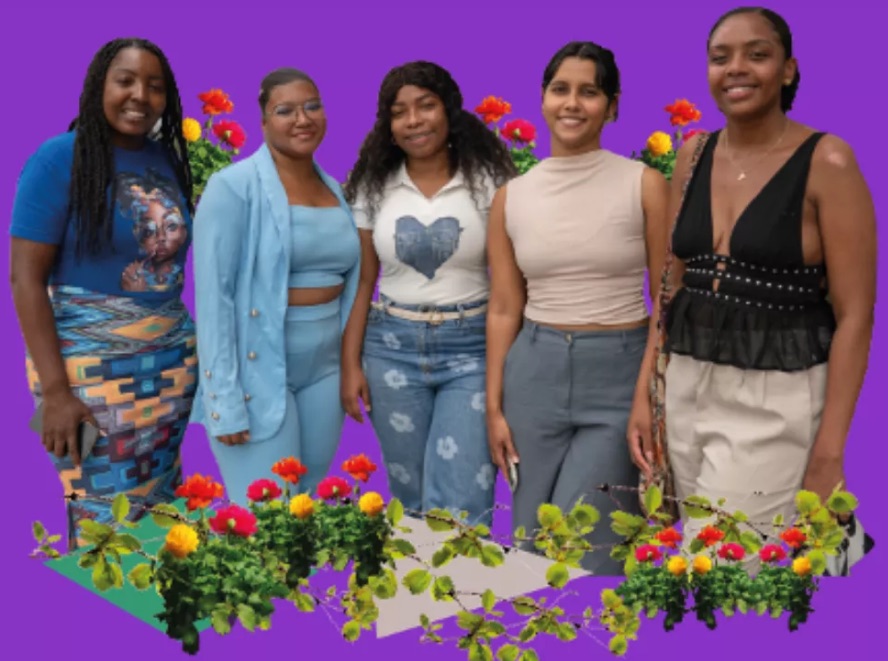
In February, our legal associate at Women’s Link, Eliana Alcalá De Ávila, participated in a community meeting in Cali, Colombia, alongside women leaders and women of African descent from the organizations La Comadre and AFRODES. The goal was to share information about access to abortion in the country from an intersectional perspective and to open a conversation about the specific barriers that Black women—women of African descent—face in exercising their sexual and reproductive rights.
The gathering took place in Llano Verde, a neighborhood in the Aguablanca district that is home to a significant Afro-descendant population and has welcomed many people displaced by violence in the country. There, at a local public school, the women who organized the event welcomed us with a deeply meaningful gesture: a space for harmonization to begin the day.
In the center of the circle were medicinal plants, flowers, gourd vessels, and dolls crafted by the communities themselves. Each object held a meaning. The plants evoked ancestral knowledge linked to sexual and reproductive health care; the gourd vessels represented the uterus; and the dolls symbolized the stories and experiences of women of African descent in their territories. That initial moment was followed by a conversation grounded in respect for community knowledge and the cultural practices that sustain the communities.
One of the leaders opened the session by reflecting on what it means to speak of reproductive justice for Black women. She recalled that their experiences with sexual and reproductive health are deeply intersected by structural racism and racial stereotypes that have shaped the way they are treated by the healthcare system.
“For many Black women, abortion is not just a sensitive or stigmatized issue. Historically, it has also been a form of resistance dating back to slavery, and recognizing that completely changes the way we understand these discussions,” Eliana noted.
During the meeting, Eliana shared information about Ruling C-055 of the Constitutional Court of Colombia, which decriminalized abortion up to the 24th week of pregnancy. The conversation centered on the participants’ specific experiences: the barriers they face in accessing health services, the violence they have endured in medical facilities, and the lack of clear information about their rights. Many women shared personal stories of obstetric violence and racial discrimination in hospitals. They recalled how, during childbirth, healthcare professionals told them they could endure more pain “because they were Black women.”
Other participants spoke of the pressure they faced from childhood to use contraception and how they were influenced by racial stereotypes regarding the sexuality of women of African descent. During the meeting, Eliana shared legal tools to address these barriers, such as the tutela action and other mechanisms that allow for the enforcement of rights. For many of the participants, this was the first time they had heard of these tools.
“Many didn’t know that abortion is decriminalized up to the 24th week, or that after that point there are still grounds that must be respected by the healthcare system. So being able to share that information, explain what to do when facing barriers, and what legal tools exist to demand their rights, was something they deeply valued,” Eliana explained.
At the end of the meeting, the participants wrote down what reproductive justice means to them. Their responses were diverse: being able to make decisions about their own bodies, receiving medical care without discrimination, accessing clear information about contraceptives, and being heard when they speak from their own knowledge and experiences. One of the reflections that resonated most with Eliana was that of a woman who said that reproductive justice for her means “the freedom to do whatever I want with my body”.
“These spaces ground us in the real-life experiences of the women we work with. They allow us to analyze how multiple forms of discrimination intersect: being a woman, being of African descent, living in a context of poverty, violence, or displacement. Understanding these intersections is essential for our work to make sense,” reflected Eliana.
At Women’s Link, these gatherings are an essential part of our work, combining strategic litigation with community organizing to democratize the law. We believe in and promote capacity-building for communities and organizations that defend rights in their territories. The event served as a reminder of the importance of holding collective gatherings that drive transformation toward different ways of understanding reproductive justice.
SOURCE: Women’s Link Worldwide, 13 April 2026