


Abortion rates have dropped sevenfold since 1989, but weekend protests and sharp rhetoric signal a deepening divide over reproductive rights.
Abortion numbers in Czechia have fallen to historic lows, but increasingly sharp political rhetoric and rival street demonstrations in Prague this weekend proved that growing tensions over reproductive rights remain.
Police and organizers said more than 4,000 people took part in the March for Life on Saturday, which began near Prague Castle and moved through the city centre in smaller groups toward Wenceslas Square. Counter-protesters attempted to block parts of the route at several points, prompting repeated police intervention.
The march, organized by the Movement for Life, and a counter-demonstration under the banner Prague Is Feminist, remained largely separate, though they briefly converged in central areas, requiring police to maintain corridors between the groups.
Five people were detained during the day, police said, adding that there were several minor blockades and one incident in which a protester struck a police officer with a banner.
The protests took place against a long-term decline in abortions in Czechia. Data from the Czech Statistical Office show recorded abortions have fallen sharply since the end of the communist era, from 113,730 in 1988 to 15,088 in 2023. The rate has dropped from about 110 per 10,000 inhabitants to roughly 14 over the same period.
While the figures suggest a steady long-term easing of abortion rates, the political rhetoric surrounding the issue has remained highly charged.
Saturday’s demonstrations brought that tension to the forefront, with lawmakers’ comments increasingly drawing scrutiny amid broader European debates over reproductive rights.
Organizers of the counter-demonstration accused the Movement for Life of pursuing a broader anti-abortion agenda beyond its stated focus on supporting women with unplanned pregnancies.
They cited alleged internal email communications attributed to Movement for Life chairman Radim Ucháč and a TV interview in which he said, among other things, that pro-life means not only banning abortions, but also the issue of artificial insemination, the issue of human sexuality, and raising children.
During the day, a comment by newly elected MP Josef Nerušil of the Freedom and Direct Democracy party (SPD) drew criticism from coalition colleagues and legal experts, who described it as discriminatory and potentially illegal under Czech and EU anti-discrimination law. In a video shared on social media, Nerušil was seen speaking to counter-protesters, which included LGBTQ+ activists, saying: “I hope none of these diagnoses will have children, because your children would be of no benefit to our society.” Nerušil told Seznam Zprávy he had not been addressing LGBTQ+ participants but members of a group he claimed films and monetises attacks on elderly residents.
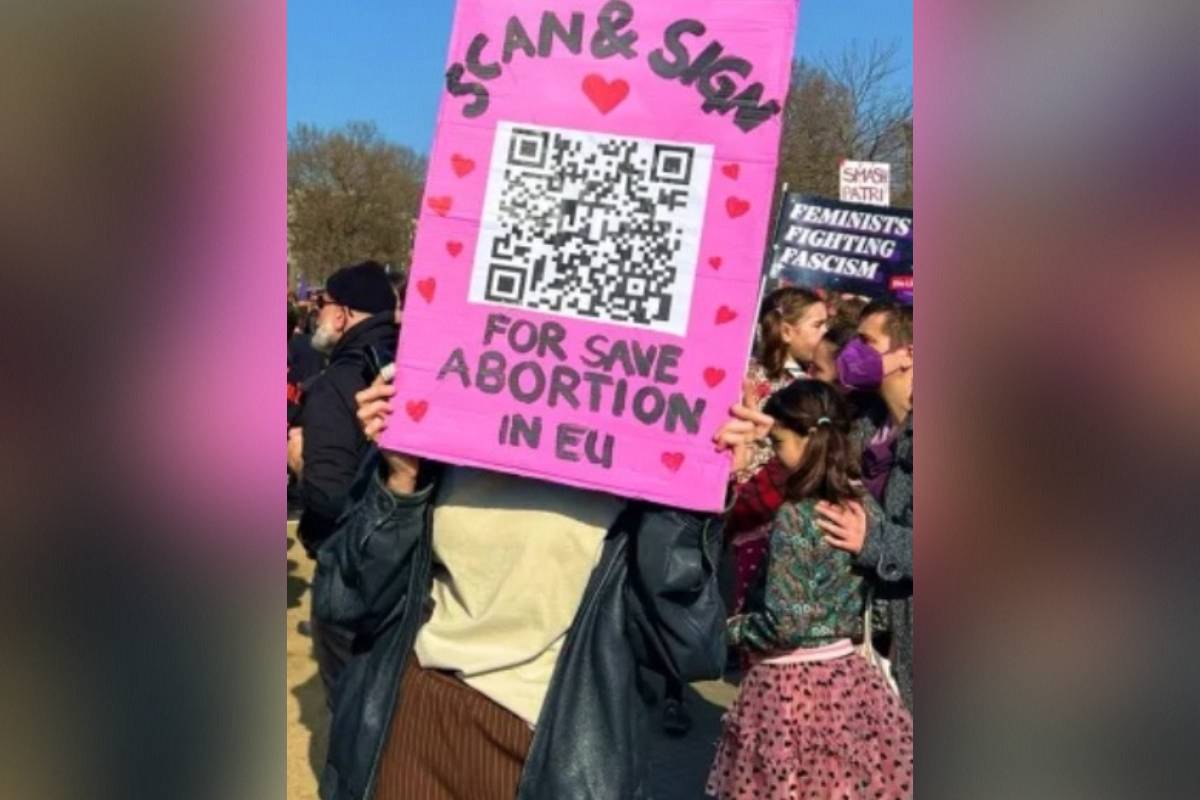
The weekend events also came amid a broader European debate on reproductive rights. In February, the European Commission said member states could use EU funds to support access to abortion services, including covering travel costs in some cases, following a European Citizens’ Initiative, “My Voice, My Choice,” which gathered more than 1.2 million validated signatures and prompted a formal response from the Commission.
For advocates, it represented a meaningful, if incomplete, step forward, but for some women residing in Czechia, the incompleteness matters. While abortion has been legal in Czechia since 1957 and access for citizens is generally straightforward in practice, a report by the Abortion Support Alliance Prague (ASAP) group revealed that access can be uneven for foreign nationals, due to administrative requirements, hospital-level policies, and differing interpretations of eligibility rules. Abortion is legal in Czechia, but foreign women, particularly those from outside the EU, face numerous obstacles when seeking safe and timely abortion care. The latest report (late 2024) from the Abortion Support Alliance Prague (ASAP), published in March 2025, found that out of nearly 80 state hospitals surveyed, 5 percent were uncertain about providing abortions to non-citizens. Meanwhile, 43 percent refused to offer abortion services to EU citizens, citing either legal uncertainty or restrictive internal policies.
Legal ambiguity stems from outdated laws that state abortion should not be performed on foreign nationals “temporarily” residing in the country. While EU citizens are guaranteed access, the laws for non-EU citizens are more complex. Many hospitals follow a conservative interpretation advised by the Czech Medical Chamber, leading to significant disparities in abortion access based on nationality.
Administrative, financial, and language barriers
Non-Czech residents also face administrative, financial, and social hurdles that make accessing essential healthcare services difficult and stressful. Nearly half of hospitals require consultations to be scheduled by phone, creating barriers for non-Czech speakers and those with hearing impairments.
According to Nowaczyk, these obstacles can lead to delays in critical situations, where time is of the essence and patients are at risk of making uninformed choices.
Financial barriers also play a role. Non-EU residents who opt for elective procedures must pay out-of-pocket, and costs vary widely across the country, with obvious consequences.
Despite Czechia’s relatively progressive stance on reproductive rights, its approach to medical abortion deviates from World Health Organization (WHO) guidelines in both time frame and patient autonomy. While WHO recommends medication abortion up to the 12th week of pregnancy, Czech hospitals typically offer abortion pills only up to the 7th or 8th week. “The use of Mispregnol and Mifegyne in Czechia was approved for abortion up to 49 days, limiting medical abortion to seven weeks,” says Nowaczyk, adding that this restriction reduces accessibility and limits individual choice.
The cost of an early-stage surgical abortion in Prague is CZK 4,700, increasing to CZK 5,200 after 8 weeks. A self-administered medical abortion costs CZK 4,775. “In most hospitals, the price of medical abortion is higher than the price of an early-stage mini-abortion,” further deterring patients from choosing the medication option, Nowaczyk adds.
Since abortion pills are not available after eight weeks, women seeking a later-stage abortion are forced to undergo a mechanical procedure at a clinic or hospital. Meanwhile, feminist organizations and the WHO agree that managing an abortion at home is both safe and empowering.
Toolbox
-Czechia’s law on access to abortion for EU citizens is here.
-Anyone denied an abortion is encouraged to appeal to the Ministry of Health or lodge a complaint with the medical facility.
–Women Help Women offers abortion pills and other services and advice.
-See the My Voice, My Choice map of collecting points.
The way forward
As abortion access faces challenges worldwide—particularly in the U.S., Poland, and neighbouring Slovakia—activist groups in Czechia are working to safeguard reproductive rights and ensure women have access to abortion services regardless of their nationality.
The My Voice, My Choice campaign is pushing for EU-wide support for women seeking abortion care in countries where access is restricted. The initiative has already gathered over one million signatures and continues to gain momentum, says Keli Renaux, a French-Thai expat speaking for the Czech arm of the EU-wide initiative.
“In Czechia, abortion is still largely seen as a politically sensitive issue,” she says. “There’s support, but it’s not always vocal.” The campaign has seen more traction in France.
“It’s a widely discussed topic, and with over 100,000 signatures in France, it’s less of a taboo.”
Both women note that the situation in Czechia reflects a broader trend across Europe, where conservative and far-right movements are putting reproductive rights at risk. Renaux adds that even in countries like Italy and Germany, where abortion is legal, like Czechia it’s still expensive, and in some areas, the number of practitioners is limited.
Advocacy groups like My Voice, My Choice, push for more transparent policies, standardized pricing, and enhanced language accessibility. They send a clear message that healthcare in Czechia should no longer be determined by nationality, financial status, or language proficiency.
SOURCE: expats.cz, by Elizabeth Zahradnicek-Haas. Published 7-03-25, updated 18-03-25.