


by Brooke W Bullington, Katherine Tumlinson, Leigh Senderowicz, Joanna Maselko, Kavita Shah Arora, Jessie K Edwards, Audrey Pettifor
Studies in Family Planning, 23 October 2025, https://doi.org/10.1111/sifp.70038, Open access
Abstract
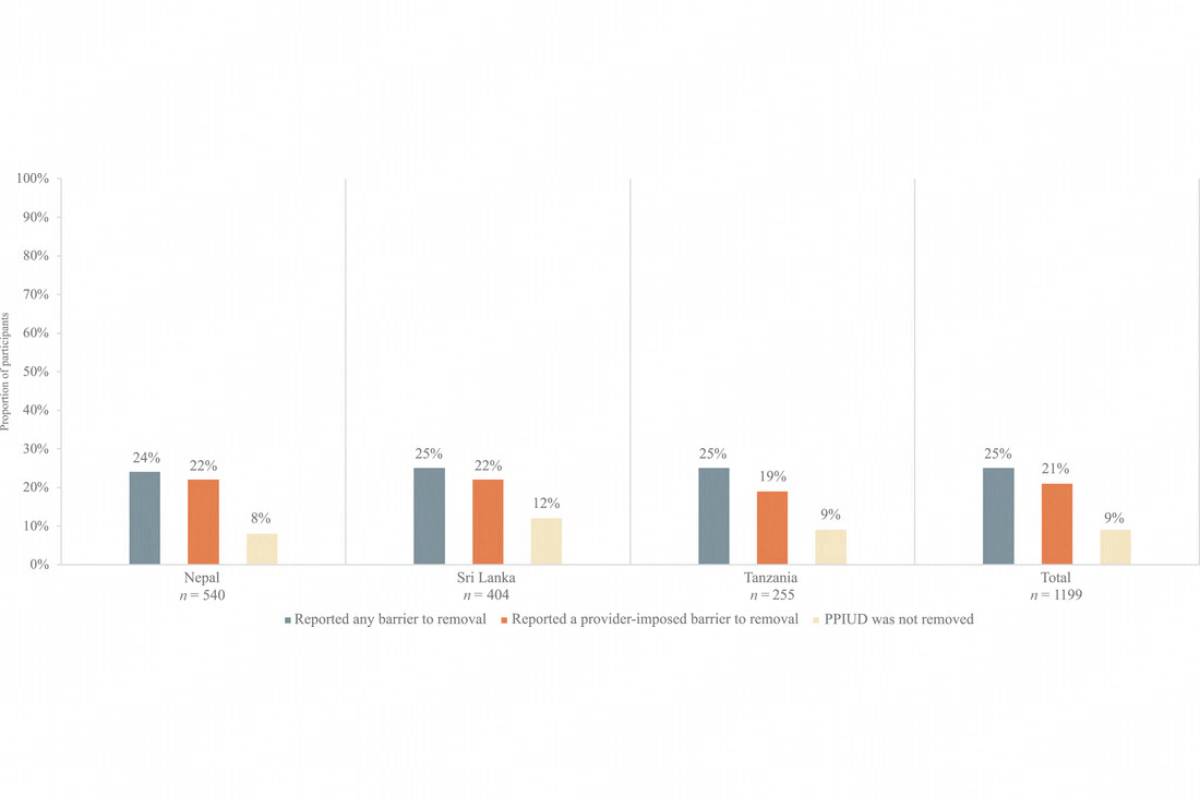
Family planning programs in the Global South promote long-acting reversible contraception (LARC), but research suggests that women face barriers to LARC discontinuation, inhibiting their reproductive autonomy. Scholars have called for improved data visibility around LARC removal access. We use data from the Postpartum Intrauterine Device (PPIUD) Study, a randomized trial of a PPIUD intervention conducted in Nepal, Sri Lanka, and Tanzania from 2015 to 2018. Among women who adopted PPIUDs, we describe PPIUD status (in-use, expelled, deliberately removed) at three follow-up points. We report the proportion of participants who sought PPIUD removal and, among those, whether they faced barriers to removal. About three-quarters of 5370 participants had their PPIUD in use 18 months following insertion; one-fifth had their PPIUD deliberately removed, and 6 percent had their PPIUD expelled. Of the 22 percent of participants who sought PPIUD removal, a quarter faced a barrier to removal; most barriers were provider-imposed. In conjunction with existing literature, our findings highlight that barriers to LARC removal are structural, rooted in larger public health and demographic goals that aim to promote contraceptive uptake. We call for safeguards to ensure that people who desire LARC removal can discontinue their method.
From the Introduction
Long-acting reversible contraception (LARC), which includes subdermal implants and intrauterine devices (IUDs), has been lauded by researchers and clinicians as “first line” due to its safety, effectiveness, easy maintenance, and long duration of use. Because LARC has been considered underutilized in low- and middle-income countries (LMICs), family planning programs have increasingly promoted these methods in recent decades. Programs that expand access to the implant, like the donor-funded Implant Access Initiative, have been deemed successful by program evaluators; there has been a substantial increase in the prevalence of implant use in LMICs. In fact, in some LMICs, including Burkina Faso and Kenya, the implant has become one of the most commonly used contraceptive methods. Uptake of IUDs, on the other hand, has remained what international funding agencies and researchers have deemed “low”. In the past 10 years, government foundations and large international organizations have therefore funded initiatives to “revitalize the IUD agenda” and increase IUD prevalence, with a particular focus on the postpartum period to increase interpregnancy intervals.
Increasing the availability of a wide array of contraceptive methods, including IUDs, is imperative to promote autonomy in contraceptive decision-making. In fact, full choice—that is, whether an individual can make a decision about contraception with access to a wide range of methods—is one of the three subdomains of Senderowicz’s conception of contraceptive autonomy. Studies have shown that individuals have unique and diverse preferences regarding contraceptive attributes; increasing the number of methods available can help ensure that these preferences can be realized. Thus, expanding access to LARC is an important step toward person-centered family planning service delivery.
However, evidence suggests that programs to introduce or expand access to certain contraceptive methods in LMICs have, at times, inhibited access to other methods and thereby devalued individual preferences. For example, studies evaluating a postpartum intrauterine device (PPIUD) intervention in Tanzania found that the intervention led providers to emphasize the IUD and de-emphasize other methods in their contraceptive counseling. This type of method overpromotion may be especially common among programs that are evaluated primarily based on uptake-focused measures of success—that is, whether people adopted the PPIUD—rather than measures of quality of care, agency, or autonomy. Overpromotion may also be common when the methods being introduced are situated as “better” than other methods available. This can be particularly concerning in the context of medical paternalism, when well-meaning providers believe they know what contraceptive option suits a person better than that person themselves, or providers insert their own beliefs about who should or should not be contracepting or bearing children.
Reproductive justice scholars have long cautioned against the “LARC-first” approach to contraceptive programming and counseling, in which long-acting methods are emphasized and promoted as the “best” contraceptive option for most or all users, while short-acting methods are de-emphasized or ignored. As Gubrium and colleagues state, “positioning any method as the first-line choice invites a lack of regard for the preferences of people who have the capacity to get pregnant”. Scholars have further argued that framing LARC as a solution to social problems, a panacea for unintended pregnancy, or a means for reducing population growth ignores and potentially contributes to deeply rooted structural inequities and the history of eugenics and reproductive coercion that has targeted low-income women, women of color, and women from the Global South. This framing places the onus of these structural problems on individual reproductive choices and puts pressure on providers to promote certain methods as a means of “transforming statistics”.
Another concern of the “LARC-first” approach is that LARC is what Clarke called “imposable,” that is, controlled by clinicians and not the method users themselves. Individuals wishing to adopt or discontinue LARC rely on a trained provider for insertion and removal. Scholars have warned that the “imposability” of LARC makes it “inherently more capable of being used coercively”. While a small body of literature explores IUD self-removal, this means of users regaining control of discontinuation has not been widely studied or promoted… (continues).