


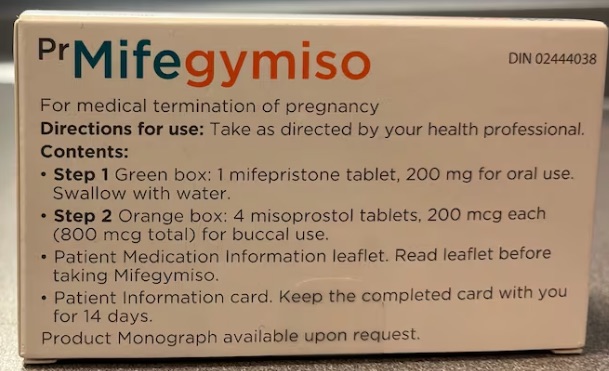
Years after Quebec loosened restrictions on the medical abortion pill, the province saw nearly an 80 per cent increase in use in 2025, according to statistics from the Quebec public health insurance board, also known as RAMQ. A total of 2,852 women were reimbursed for taking Mifegymiso last year, compared to 1,586 in 2024. The medication allows for people to have an abortion naturally, without the need for a surgical procedure.
“It’s been used around the world for years,” said Dr. Diane Francoeur, OBGYN and CEO of the Society of Obstetricians and Gynaecologists of Canada. “It was only in 2022 that Quebec lifted a series of requirements surrounding the drug — making it significantly more accessible. But the higher rates of medication abortions do not mean abortions are necessarily increasing,” says Francoeur.
Experts in the province say abortion rates in Quebec are relatively stable and the increase in prescriptions for the abortion pill is good news, in part due to its safety and accessibility. “It’s a good thing the numbers are increasing, considering Quebec is “the most behind in all of Canada,” said Dr. Mathieu Bélanger, an obstetrician-gynecologist at the CHU de Québec-Université Laval hospital.
“It can be prescribed, and people can do it at home. We know it’s safe and, like it or not, word of mouth is spreading,” he told Radio-Canada.
After medication abortion was approved by Health Canada in 2015, there were some “very rigid” prescribing parameters that were quickly dropped by most of the country, says Jess Legault, the general co-ordinator of Quebec’s family planning organization (FQPN). That wasn’t the case in Quebec. She says Quebec doctors were required to be trained for procedural abortions, known as dilation and curettage (D&C), if they were to prescribe medical abortions — the pill. Patients also had to have an ultrasound. Holding onto these restrictions was “not based on science,” says Legault. “That really restricted who would be able to prescribe,” she said.
The FQPN was among groups putting pressure on the Quebec College of Physicians to make the medication more available — especially after the overturning of Roe V. Wade in the U.S.
- Trump’s re-election pushes Quebec to call for safeguarding women’s right to choose
- Quebec launches action plan to improve access to abortion, protect women’s right to choose
In the last couple of years, Legault says the government put in place a plan to increase access in Quebec. Announced in 2024 by Martine Biron, then minister responsible for the status of women, the plan outlined 28 measures based on four general objectives: facilitating access to abortion in the regions, combating misinformation, improving information on contraception and promoting research.
Currently, doctors, specialized nurse practitioners and midwives can prescribe the abortion pill. In some cases, it can also be prescribed via telemedicine. Legault says it’s partly why the province might be seeing higher numbers now — adding there is also a lot more information available.

Dr Francoeur
Dr Francoeur suspects another reason explaining the rise in the use of the pill has to do with more women turning to the medication when a fetus stops growing in the womb. “The baby is not coming out on its own, but it’s there, and sometimes it may take weeks before the pregnancy will be expelled,” said Francoeur. Previously, doctors had to perform a procedural abortion, she says. Now, they have options.
SOURCE: CBC News, by Rachel Watts, 12 February 2026.