


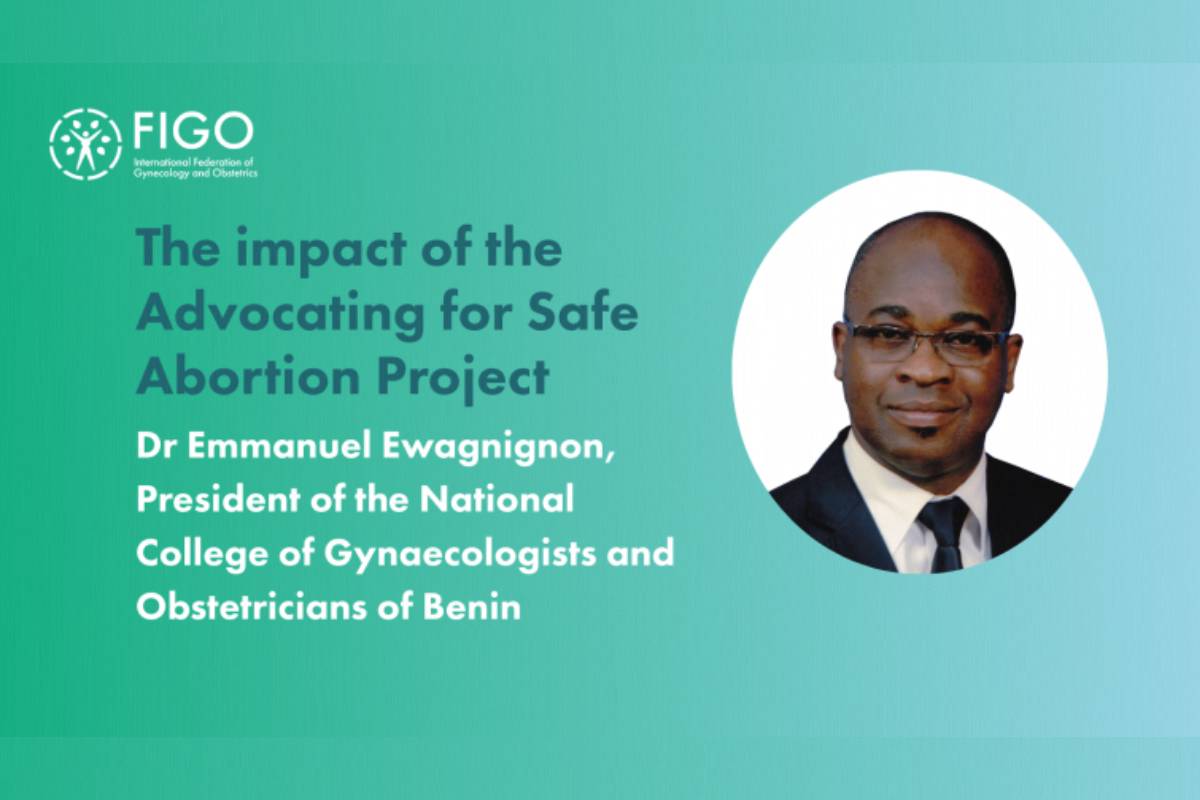
For years in Benin, unsafe abortion was a silent killer. Every year, nearly 500 women and girls died – not from rare diseases or unavoidable complications, but from clandestine unsafe procedures carried out in secrecy and fear. Lives lost quietly, often unnamed.
Dr Emmanuel Ewagnignon, President of the National College of Gynaecologists and Obstetricians of Benin (CNGOB) saw the consequences firsthand.
As doctors, we have seen many things. We were receiving women that have had perforated their uteruses or used toxic concoctions to induce abortion. These dangerous methods tear down the vaginal wall, leaving the women with serious health consequences. We see women whose bodies are destroyed. And many of them do not survive.
Dr Ewagnignon knew the problem was not ignorance. It was silence – reinforced by stigma, tradition and fear of the law.
Turning shock into change
When CNGOB, with support from FIGO, launched the Advocating for Safe Abortion Project, the goal was not to “promote abortion,” as critics feared. It was to stop women from dying.
The strategy was radical in its simplicity: talk to everyone.
We talked to hairdressers, seamstresses. domestic workers, religious leaders, lawyers, magistrates, police officers, politicians – no level was left out. We showed them all the crude reality of clandestine abortions.
Some of those conversations were deliberately uncomfortable. Members of parliament were shown graphic medical images – not to shock for shock’s sake, but to make denial impossible. To instill the need for change.
When beliefs meet reality
In Benin, faith runs deep. Abortion was widely seen as morally unacceptable, no matter the circumstances. Religious leaders, particularly Catholic leaders, had long blocked reform.
But reality proved harder to ignore.
The women dying of unsafe abortion practices are our wives, our daughters, our sisters, our mothers. If the woman you love the most is in danger of losing her life, would you let her die?
Slowly, some attitudes started to shift. Religious leaders began to accept that while abortion conflicted with their beliefs, refusing it in all circumstances could mean death. Even among those who never fully agreed, there was growing recognition that compassion had to have a place in the law.
A law that saves lives
Benin already had a sexual and reproductive health law, but advocacy strengthened it.
After intense debate, resistance and political negotiation, a revised law was passed and later promulgated by the President of the Republic. It allows safe abortion under clearly defined conditions, up to 12 weeks of pregnancy.
It was a turning point.
The impact of the revised law was immediate. Unsafe abortions decreased. Women were no longer automatically condemned. Healthcare providers felt protected enough to act. Lives were saved.
Passing a law, however, is only the first step.
Making the law work for people
Today, Dr Ewagnignon’s biggest concern is awareness. Even magistrates — the very people responsible for enforcing the law – sometimes do not know what it says.
Misinformation spreads easily. Those who once profited from illegal abortions warn women that safe abortion is a trap – that they will be arrested if they seek care. Without continued funding and public education, fear threatens to undo progress.
Still, there are signs of hope.
The Ministry of Health requires healthcare providers who object to abortion to formally declare it – and obliges them to refer women elsewhere without delay. Medical facilities are being assessed and approved to provide safe abortion care. The government is actively working to ensure the law is enforced.
If this law is fully implemented, we could go from 500 deaths to zero.
Beyond the law: building leadership
For Dr Ewagnignon, the project’s impact went beyond legislation.
With FIGO’s support, CNGOB transformed from a group of technical health experts into a strong, well-governed professional body. Doctors learned leadership, management, and accountability – skills needed to sustain long-term change.
Before, we were just health professionals. Now, we can manage projects, advocate, lead and effect change.
That capacity may be just as important as the law itself, especially with elections approaching and uncertainty about future political leadership.
Protecting the women in our lives
When asked what he is most proud of, Dr Ewagnignon does not hesitate.
We are saving the lives of young women and girls. We are protecting the women in our lives.
For him, advocacy is not abstract. It is personal. It is about refusing to accept that death is the price of silence – and insisting that compassion, courage and evidence can change even the most deeply held beliefs.
Every woman who survives because she no longer had to risk a clandestine unsafe abortion is proof that learning, and acting, is worth it.
SOURCE: FIGO News, by Reyes Castellano, Senior Communications and Engagement Manager, 12 February 2026.