


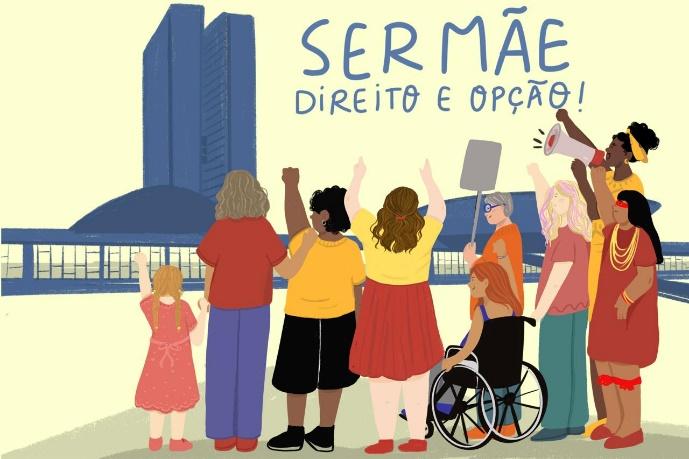
Campaign on abortion rights comes to Recife
On March 28th and 29th, for the International Day of Action for Women’s Health, the 3rd stage of CEPIA’s National Campaign on Abortion took over the streets of Recife with projections that drew attention to the urgency of updating the legislation and guaranteeing the rights of girls and women. Billboards and bus doors remained covered with posters throughout the city, keeping the debate alive. The campaign continues and will soon reach other cities!
Watch the video: Being a mother is a right and a choice
To guide the return of Federal legislative work in Brazil, CEPIA sent a message to representatives of the Chamber of Deputies and the Federal Senate, in the form of a postcard, reminding everyone of the State’s duty to guarantee the dignity and rights of girls and women to have motherhood as an option and not as an imposition.
SOURCE: CEPIA Newsletter, 17 April 2025
+++
CEPIA takes to the streets of São Paulo with a campaign for abortion rights during Women’s Health Week
According to the 1940 Penal Code, a husband could annul a marriage if he discovered that his wife was not a virgin. While such a notion would be considered absurd today, the same 1940 Penal Code still criminalizes women who terminate a pregnancy. This contradiction illustrates how outdated laws continue to shape the current debate on abortion in Brazil. It was from this reflection that CEPIA launched a powerful mobilization in São Paulo.
During the week of May 28th – International Day of Action for Women’s Health and National Day for the Reduction of Maternal Mortality – artistic interventions occupied Avenida Paulista over two days. One particularly striking and symbolic action featured a wedding dress discarded in a trash bin. This urban performance aimed to spark reflection on the historical control of women’s bodies and the urgent need to decriminalize abortion in Brazil, drawing attention from passersby and initiating dialogue with the public.
The action gained widespread visibility, particularly through nighttime projections on buildings around the city, which displayed powerful phrases about reproductive rights. In addition to the performance and projections, the campaign also included large posters on news-stands, expanding the reach of its message and encouraging debate on bodily autonomy and reproductive justice. The mobilization was highlighted in the media, including in an article by Revista Fórum, which emphasized the dangers of unsafe abortion in Brazil, and in a special report by TVT.
+++
Civil code: movements identify threats to rights such as abortion and the right to heritage
On May 15th, the organizations that make up the Maria da Penha Law Consortium and various other feminist organizations began a series of meetings to analyze and debate, from a gender and intersectional perspective, the Draft Bill to reform the 2002 Civil Code. This legislative change was proposed by the Federal Senate, which created a committee of jurists that gave rise to Bill 4 of 2025. Leila Linhares Barsted took part in this meeting when numerous articles were identified that will have a retrograde effect on issues such as abortion and the right to inheritance, among others.
On May 19th, the State Coordination for Women in Situations of Domestic and Family Violence (COEM) of the Rio de Janeiro State Court of Justice held another meeting of its Working Group on Obstetric Violence, where the various violations of health and reproductive rights were presented and debated, as well as suggestions for public policies to guarantee and make these rights effective.
+++
Health and Human Rights: Territories in Dispute
The Harvard University Journal Health and Human Rights published Jacqueline Pitanguy’s article Health and Human Rights: Territories in Dispute in its May 29th issue. The article draws attention to the fact that while the debate on abortion in countries with secular governments, such as Brazil, should be based on the premise that unsafe abortion contributes significantly to high rates of maternal mortality and is a violation of the right to health, it instead incorporates moral and religious arguments that feature strong patriarchal perspectives on women’s autonomy and on gender roles and power in the family, education, workforce, and politics.
SOURCE: CEPIA NEWSLETTER 16 June 2025
+++
Why we must keep talking about abortion pills
“As part of a delegation to Brazil, I saw how our countries’ respective struggles to maintain and expand reproductive justice are really part of the same fight.” (Erika Kokay, Congresswoman for the Workers’ Party)
Brasília — We packed ourselves into a meeting room at the back of the Socialism and Freedom Party (known as PSOL) office in the National Congress building in Brasília on May 14.
Pesticide contamination can have devastating consequences for children and pregnant people. One 2024 study found that in the major agribusiness cities in Mato Grosso, which is one of the largest exporters of soybeans and cattle in the country, the risk of congenital anomalies was 20 percent higher than in non-farming regions, while the risk of fetal death was 30 percent higher. And tragically, the risk of dying before birth was 73 percent higher in parts of Rio Grande do Sul, where Dialogue Earth has reported that farmers have sued pesticide manufacturers and state and local governments to ban spraying pesticides by plane.
For a number of women in these communities, explained Xakriabá, they are seeking abortions “not because they chose. It’s because of the pesticide [contamination] rates.” She said that women and children become contaminated with mercury because of illegal mining and heavy metals, and “a lot of women don’t want to get pregnant because their children will be born with disease or malformations.”
In Brazil, patients are permitted legal abortions only after qualifying for one of the three exceptions—the pregnancy was the result of rape or incest, the pregnant person’s life is at risk, or the fetus has been diagnosed with anencephaly (a fatal birth defect)—but then they also have to access that care at a public hospital. Qualifying abortions are covered under the country’s universal health care program, the Unified Health System. However, public facilities that offer abortion care (60 percent of all hospitals, according to Dr. Andréia Regina Aráujo, who spoke to the delegation at the Hospital Materno Infantil de Brasília) tend to be in densely populated areas that are often difficult for people in rural communities to reach.
There is a case before the Brazilian Supreme Court that could decriminalize abortion during the first 12 weeks of pregnancy, but the court has postponed debating the issue, with no new date set. And although leftist leader Luiz Inácio Lula da Silva assumed the presidency after defeating the far-right incumbent Jair Bolsonaro in 2022, conservatives in the federal legislature are pushing a bill that would treat abortion after 22 weeks as a homicide.
Not only is the status quo under threat, she explained, but conservative lawmakers “want to go back.” They have presented many proposals, she said, including personhood legislation to define life as beginning at conception, “which would criminalize any interruption of pregnancy.” They are also trying to take away emergency contraception. “Every day it’s something else,” she said. “We fight every day not to go backward.”
The lack of access to legal abortion care pushes Brazilians to seek abortions through illegal means, with many obtaining Cytotec, or misoprostol, from drug traffickers. As even the World Health Organization has noted, the pills are safe to use when terminating a pregnancy, but when patients buy the pills on the black market and, as local providers explained to the delegation, do not receive enough of them to complete the process—the misoprostol-only regimen can require up to 12 pills, four at a time in three doses—complications may arise, contributing to the country’s maternal health crisis.
Abortion care is a crucial part of the spectrum of reproductive health care, which includes pregnancy prevention, termination, and labor and delivery. By making abortions inaccessible, lawmakers endanger those most unable to access care in a health crisis, whether they had planned to end the pregnancy or carry it to full term. Abortion pills, for example, are used to manage postpartum bleeding—a leading cause of death in the United States and around the world. But when providers need to clear legal hoops before they can give their patient a dose, healthcare suffers. Julia Piazza, a Brazilian lawyer and member of the Feminist Collective on Sexuality and Health, told us, “There are some advocates who say the medication is in jail. Not just for abortions but for it to be used in different cases when they are necessary.”
Misoprostol became available in Brazil in the late 1980s, and was first prescribed as a treatment for gastric ulcers. Thanks to the ingenuity of drugstore vendors and people of color in favelas, who would tell the community pharmacists which medications worked best, word spread that misoprostol worked better than others, and drug stores would sell the pills without a prescription to get around the country’s strict abortion laws. But the medication became so popular that misinformation about its use began to spread, and in 1991, the Ministry of Health banned the pills unless they were being sold for ulcers. Today, under the country’s restrictive laws, misoprostol can be dispersed for medication abortions only in public hospitals.
Brazilians continue to access misoprostol through legal and illegal means, but the propaganda about medication abortions continues, thanks to the country’s anti-abortion movement that is heavily influenced by, or in some cases even backed by, the same organizations operating in the United States, as Garnet Henderson reported for Rewire News Group.

Lucia Maria Xavier de Castro, the founder of Criola
PHOTO: Kisha Bari
We also met with the Rio de Janeiro–based reproductive justice organization Criola, who told us about their work raising awareness and empowering Afro-Brazilians. Criola’s founder, Lucia Maria Xavier de Castro, explained to me that Afro-Brazilians who become pregnant often lack the community support and resources that they need, whether they decide to keep the pregnancy or seek an abortion, which is why the organization has worked under a reproductive justice framework since its founding in 1992.
Criola works to combat the “patriarchal cis-heteronormative racism” at the root of this crisis facing Black youth and adults, both cis and trans, through community meetings, conversation circles, education materials, and research. “What we offer, with a lot of care, is more information so that [Black women] can understand that this is not personal and happens to other women as well, and that she has to seek services that are safe for her, because if not, the chances of dying are enormous,” she said through a translator. Criola informs Black pregnant people “so that they understand what is at stake when they make these decisions, what the problems are that they are going to face, and how they can solve the problems from their position.”
Beyond addressing stigma and misinformation in the media and organizing communities and neighbors to protect one another, advocates are working at the national level to improve care. The Collective of Nurses, Midwives, and Obstetricians for the Right to Decide formed one year ago to steward best practices among those caring for abortion patients and improve the codes governing their work so that they are patient-centered. Like advocates in US states with abortion bans, the collective recognizes that it’s crucial to improve not only access to abortion but also the structures of the care system that often prevent providers from meeting the needs of their communities.
SOURCE: The Nation, by Regina Mahone, Senior Editor, 16 June 2025.